Where Can I Buy Teak Wood: Quality Sources And Price Guide
You can buy high-quality teak wood from FSC-certified suppliers who clearly specify grades, ensuring you get dense, oil-rich Grade A heartwood. Expect Myanmar teak to cost more but offer superior durability and grain compared to plantation teak, which suits budget-conscious projects.
Whether purchasing online or in-store, verify authenticity, source legality, and certification to avoid mislabeling. Understanding these factors will help you pinpoint the best teak options, prices, and sourcing practices for your needs.
Key Takeaways
- Buy Grade A teak heartwood from reputable suppliers for high density, natural oil content, and durability.
- Choose FSC-certified teak to ensure sustainable, legal, and ethically sourced wood.
- Myanmar teak commands premium prices due to superior quality, while plantation teak offers affordability with moderate durability.
- Inspect teak in-store for grain, color, and texture, or buy online from vendors providing clear grading and certification.
- Compare prices across FSC-certified suppliers and consider bulk buying or seasonal discounts to get the best deals.
How to Identify Quality Grades of Teak Wood
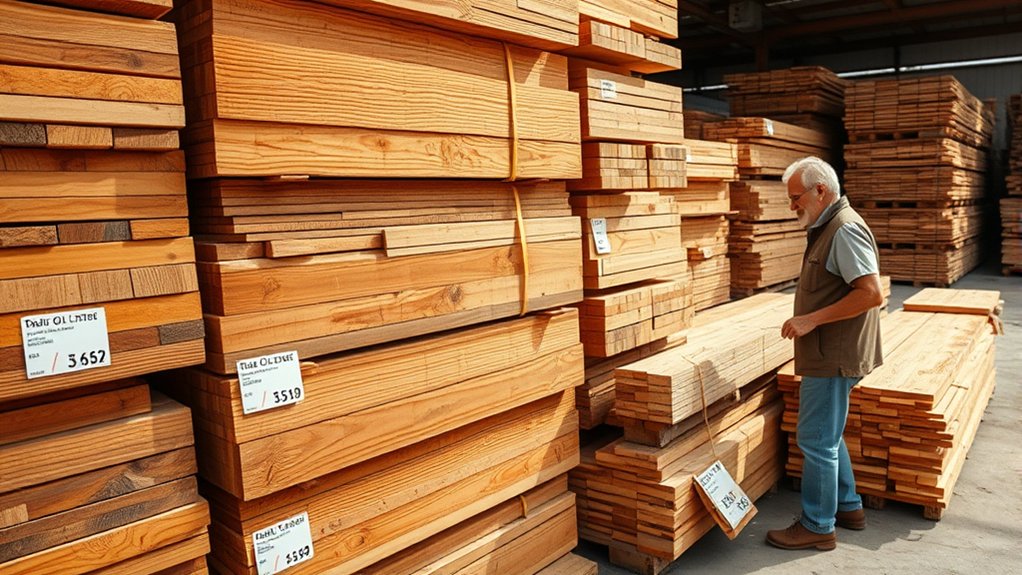
Identifying quality grades of teak wood hinges on understanding its source and physical traits.
When evaluating the grade of teak, focus on its origin within the tree. Grade A teak wood comes from the heartwood of mature trees, exhibiting high density, maximum natural oil content, and an almost knot-free surface. This grade guarantees superior durability and resistance.
Grade B teak, taken from the area surrounding the heartwood, has slightly lower density and oil levels, with occasional small knots. It makes a cost-effective alternative without sacrificing too much quality.
Grade C teak, or sapwood, is near the bark, lighter in color, less dense, and lacks oils. This reduces its durability.
You should be cautious, as mislabeling lower-grade teak as higher grades affects performance and value.
How to Compare Prices of Myanmar and Plantation Teak
Once you’ve determined the quality grade of teak wood, the next step is to evaluate price differences between Myanmar and plantation teak. Myanmar teak, with its higher silica content and consistent grain, commands a premium. FEQ grades start around $32.00 per 6/4 lumber.
Plantation teak features wider growth rings and lower density, making it more affordable due to its abundant supply. When comparing prices, factor in Myanmar teak’s superior durability and aesthetic appeal. These qualities justify its cost, especially in demanding applications.
However, plantation teak offers a cost-effective alternative for siding and decking but may underperform in extreme conditions.
Plantation teak provides an affordable option for siding and decking, though it may falter in harsh environments.
Also, verify sourcing legitimacy since legal complexities surrounding Myanmar teak can affect price and availability. This precise evaluation helps you balance quality and budget efficiently.
Why FSC-Certified Teak Matters for Sustainable Buying
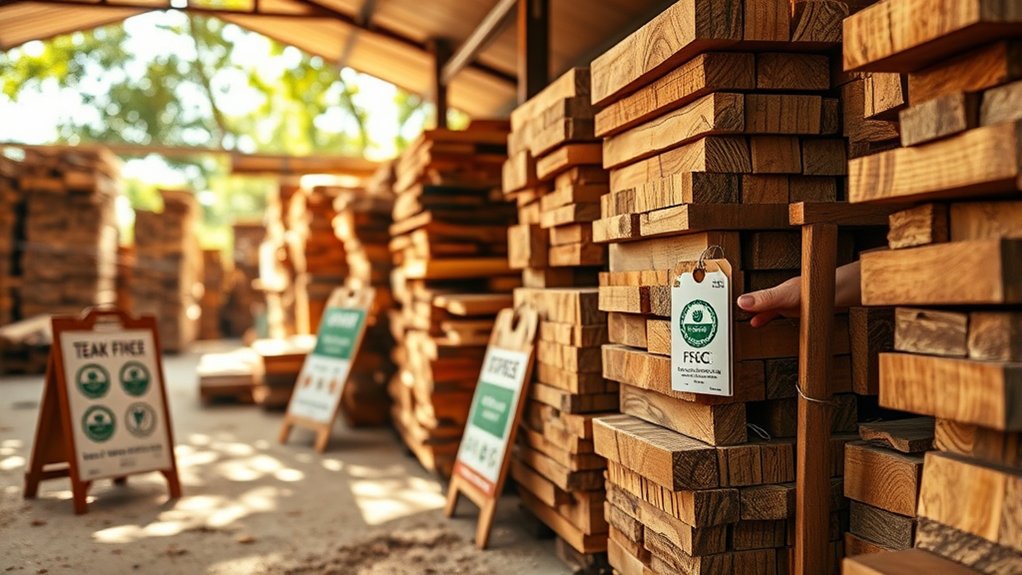
When you choose FSC-certified teak, you’re making sure the wood comes from forests that are carefully managed to protect biodiversity and keep ecosystems healthy.
This certification means the teak is sourced ethically, following strict social and environmental rules. It helps prevent illegal logging and stops forests from being damaged.
Environmental Impact Benefits
Choosing FSC-certified teak brings multiple environmental benefits that make your purchase truly sustainable. FSC teak comes from forests managed under strict environmental standards, which help curb deforestation and preserve biodiversity. You’ll be supporting responsible logging practices designed to protect both ecosystems and local communities.
This certification also promotes reforestation efforts, helping maintain carbon balance by offsetting emissions. When you select FSC teak, you’re guaranteed traceability, confirming your wood’s legal and environmentally sound origin. So, you can feel confident about where your wood comes from.
Your purchase directly contributes to conserving natural habitats while fostering economic stability for communities that depend on forestry. In the end, choosing FSC-certified teak significantly reduces the environmental impact of your wood procurement. It aligns perfectly with sustainable resource management and ecological preservation principles.
All in all, FSC teak is the superior choice for anyone who cares about the environment and wants to make a positive difference.
Ethical Sourcing Assurance
How do you guarantee the teak you buy supports ethical and sustainable forestry? Choosing FSC-certified teak is essential for ethical sourcing assurance. This certification verifies that teak comes from sustainably managed forests where logging avoids deforestation and environmental harm.
FSC standards enforce harvesting methods that maintain ecological balance, protect wildlife habitats, and promote biodiversity.
Plus, FSC-certified teak guarantees fair labor practices and respects the rights of local communities involved in forestry operations.
The certification also provides traceability, so you can verify the teak’s origin and ensure it meets strict environmental and social criteria.
By opting for FSC-certified teak, you’re not just securing responsibly sourced wood—you’re also supporting growing market demands for environmentally and socially responsible products.
It’s a great way to show your commitment to ethical sourcing.
Long-Term Forest Management
Because sustainable forestry depends on long-term forest management, FSC-certified teak plays an essential role in maintaining ecosystem health and resource longevity.
FSC-certified teak comes from forests managed under strict guidelines that minimize environmental impact, preserve biodiversity, and prevent illegal logging.
By choosing FSC-certified teak, you support practices that guarantee the regeneration and sustained productivity of teak resources.
This certification enforces responsible harvesting methods, protects native species, and fosters soil and water conservation.
Plus, FSC standards promote social responsibility by ensuring fair labor practices and benefiting local communities economically.
When you purchase FSC-certified teak, you actively contribute to sustainable forestry initiatives that balance economic needs with ecological preservation.
In doing so, you help secure high-quality wood supplies without compromising forest ecosystems for future generations.
It’s a choice that supports both the environment and the people who depend on it.
Finding Genuine Burmese and Plantation Teak

When sourcing genuine Burmese teak, you’ll want to focus on wood from Myanmar. It’s renowned for its high silica content and consistent quality. This really sets it apart from plantation teak grown in Indonesia and Malaysia.
Burmese teak offers superior density and oil content. That’s why it’s considered the benchmark for quality teak. Plantation teak, on the other hand, tends to have lower density and variable oils, which can affect durability.
To make sure you’re getting authentic Burmese teak, look for suppliers who provide detailed grading. Grade A teak comes from mature heartwood and guarantees the highest quality.
Also, check for FSC certification to confirm sustainable sourcing and compliance with forestry standards.
Trusted vendors usually have direct ties with mills and exporters. This helps ensure legality and consistent quality.
Keep these factors in mind when evaluating teak so you can secure genuine, high-performance wood for your projects.
Buying Teak Online or In-Store: What You Need to Know
When you’re buying teak online, it’s a good idea to look for suppliers who provide clear grading info and have FSC certification.
Also, check if they offer free shipping within the U.S. Plus, it’s really handy if you can return any unused boards within 30 days.
On the other hand, buying in-store lets you see the grain, color, and texture up close. This is super important because teak’s brittleness can change depending on the grade.
Either way, whether you shop online or in person, make sure you’re getting Grade A heartwood for the best density and oil content.
Online Purchase Advantages
How can you guarantee you get the best quality teak wood with minimal hassle? Buying teak online streamlines the process by offering detailed product data and broad availability. You can precisely compare grades, such as 4/4 and 8/4 lumber, ensuring you select the right specifications for your project.
Here are key advantages of purchasing teak wood online:
- Access thorough descriptions and high-resolution images to evaluate grain and color variations accurately.
- Benefit from free shipping options on qualifying orders, reducing overall cost.
- Enjoy straightforward return policies, typically allowing exchanges or refunds within 30 days.
- Obtain premium or specialty teak, including marine-grade, directly from plantations without retail markups.
This approach minimizes risk and maximizes quality assurance compared to traditional in-store buying. It just makes the whole process easier and more reliable.
In-Store Buying Tips
Choosing teak wood in-store requires a keen eye for grading and certification to assure superior quality and sustainability. Inspect teak lumber for Grade A, which has the highest oil content and durability. Avoid sapwood-laden lower grades since they won’t last as long.
Also, verify FSC certification to confirm ethical sourcing. Check the density—high quality teak weighs between 38 and 43 lbs per cubic foot. Don’t forget to confirm the store’s return policy and satisfaction guarantee before making a purchase.
Prices vary depending on thickness. For example, 4/4 lumber starts around $30, while thicker boards range from $32 to $42.50.
| Grade | Density (lbs/ft³) | Price Range (per board) |
|---|---|---|
| 4/4 | 38 – 40 | $30.00 |
| 6/4 | 40 – 42 | $32.00 – $38.00 |
| 8/4 | 42 – 43 | $38.00 – $42.50 |
| Sapwood | <38 | Avoid |
| FSC Cert. | Yes/No | Confirm before buying |
Choosing the Right Teak Wood Size and Cut
Although teak wood comes in various sizes, selecting the right length and cut for your project demands careful consideration of both dimensional requirements and wood characteristics. Since teak grows with distinct grain direction and variable hardness, you’ll want to choose cuts that best align with your intended use.
Also, controlling moisture content during selection is essential to prevent warping.
When you’re picking teak, think about the length of the boards. They come in 12″, 18″, and 30″, giving you flexibility whether you’re doing detailed work or something larger.
Thickness options like 4/4, 6/4, and 8/4 can affect the strength and the finish of your project. Grain orientation is another big deal because it impacts both durability and how nice the wood looks.
Finally, make sure the moisture content is stable. This helps avoid any changes in size after you install the wood. Taking these factors into account will help you get the best results with your teak wood.
Verifying Teak Authenticity and Legal Compliance
When sourcing teak wood, verifying its authenticity and legal compliance is essential to guarantee you receive a genuine product that meets sustainability standards.
Start by confirming the teak is from FSC-certified plantations. This ensures sustainable forestry and a transparent supply chain.
Pay close attention to the origin, especially if the teak is brown and sourced from Myanmar. Illegal imports from this region are pretty common, so it’s important to be cautious.
Also, confirm the grade. Grades A and B come from mature trees and hold higher value, unlike grade C, which may sometimes be misrepresented.
Make sure to request documentation or certifications that verify ethical sourcing and compliance with international timber trade regulations.
Finally, do some research on supplier reputations and customer reviews. This helps you make sure they stick to legal and ethical sourcing protocols, safeguarding both the authenticity and legality of your teak purchase.
How to Get the Best Deals on Teak Wood Without Sacrificing Quality
How can you secure high-quality teak wood without overspending? Prioritize sourcing from FSC-certified teak suppliers to confirm sustainable and responsible harvesting.
Understand the grading system: Grade A teak offers superior durability and aesthetics but comes at a premium, while lower grades provide cost savings with some quality trade-offs.
To get the best deals without sacrificing quality, buy directly from plantations in regions like Costa Rica to eliminate intermediary markups.
Compare prices across FSC-certified Grade A and other grades, balancing cost and performance.
Also, use reputable online marketplaces with transparent shipping and easy returns to mitigate risk.
Don’t forget to leverage bulk purchasing and seasonal discounts to reduce overall expenditure.
This strategic approach guarantees you obtain premium teak wood efficiently and sustainably.
Frequently Asked Questions
What Are the Common Uses for Teak Wood in Home Decor?
You’ll find teak furniture commonly used for its durability and rich grain in both indoor and outdoor settings. It works perfectly for patios, living rooms, and bedrooms, offering a long-lasting, weather-resistant option.
Plus, teak accessories like cutting boards and decorative accents take advantage of teak’s natural oils and moisture resistance. This makes them ideal for kitchens and artistic displays.
Its hardness and color variation really elevate any home decor with functional elegance.
How Should Teak Wood Be Maintained to Prolong Its Lifespan?
Think of teak wood as a living treasure chest. Teak wood maintenance is key to keeping its value shining. Clean it regularly with mild soap and water to avoid grime buildup.
Apply teak oil annually to nourish the wood’s natural oils and restore its glow. Light sanding before oil application helps reverse weathering. Avoid harsh chemicals or abrasives that strip oils.
Make sure to dry and store it properly to prevent warping. This will help ensure your teak lasts for generations.
Taking care of it little by little really pays off.
Can Teak Wood Be Refinished or Restored if Damaged?
Yes, you can refinish or restore teak wood if it’s damaged by using proper teak restoration techniques.
Start by sanding the surface lightly with 150 grit sandpaper. This helps remove weathered layers without harming the wood.
After sanding, apply teak wood finishes like teak oil. These finishes replenish the natural oils and help protect the wood’s moisture resistance.
Regular maintenance with these finishes boosts durability and keeps teak looking great.
So, even if your teak furniture is weathered or aged, you can effectively restore it with the right care and products.
It’s all about giving the wood some attention and protection to bring back its natural beauty.
What Are the Environmental Impacts of Teak Plantations Versus Natural Forests?
Think of teak sustainability as a delicate dance between nature and industry.
You’ll find teak plantations often reduce plantation biodiversity by replacing diverse natural forests with monocultures. This leads to habitat loss and soil erosion.
Natural forests act as essential carbon sinks. On the other hand, plantations increase greenhouse gas emissions despite FSC-certified efforts.
How Does Climate Affect the Growth and Quality of Teak Trees?
You’ll find teak growth highly sensitive to climate influence. Ideal temperatures between 68°F and 95°F accelerate development and increase oil content, enhancing wood durability.
A clear wet and dry seasonal cycle with 40-100 inches of rainfall guarantees healthy growth phases.
Well-drained, fertile soils combined with moderate humidity support density and resistance.
Too much moisture risks fungal damage, while drought or flooding disrupt growth rates and reduce wood quality.
This all affects teak’s final properties.
Conclusion
When buying teak wood, don’t put all your eggs in one basket. Compare quality grades, prices, and sources carefully.
Prioritize FSC-certified options to guarantee sustainability and legal compliance. Whether you choose genuine Burmese or plantation teak, verify authenticity and pick the right size for your project.
By doing thorough research and knowing where to look, you’ll secure the best deal without compromising on quality. This way, your investment will be both smart and durable.