Can Wood Conduct Electricity: What You Need To Know About Wood Properties
You’ll find that dry wood naturally resists electricity because its dense cellulose fibers and air pockets block electron flow, making it a poor conductor. However, when wood absorbs moisture, ionized water increases its conductivity sharply, especially along the end grain.
Chemical treatments can further boost conductivity by adding free ions. Measuring wood’s electrical behavior involves accounting for moisture and grain orientation. If you want to grasp how these factors influence wood’s dual insulating and conductive roles, there’s more detailed insight ahead.
What Makes Wood a Natural Insulator Against Electricity?
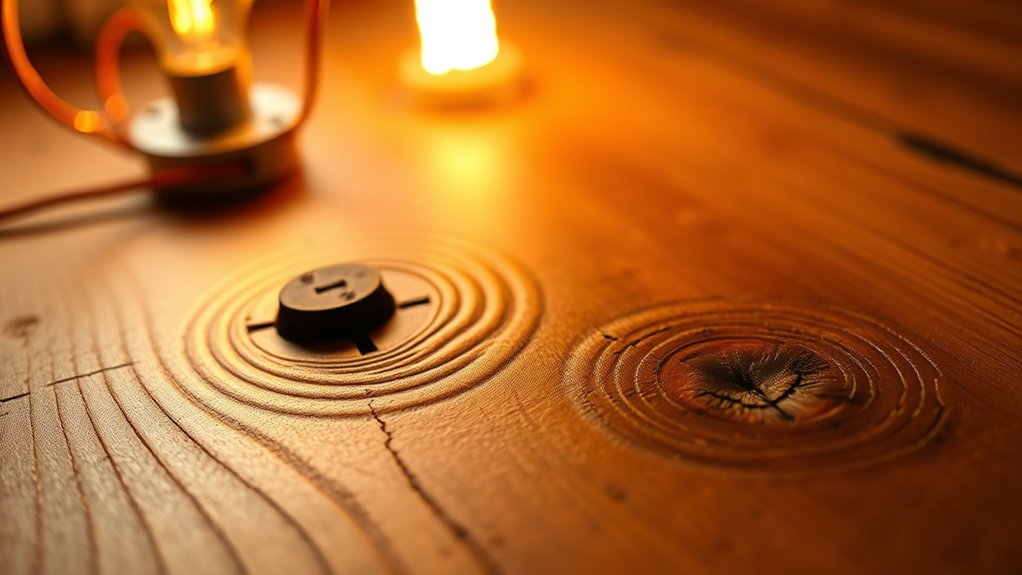
Although wood’s composition might seem straightforward, its tightly bound cellulose fibers play an essential role in restricting the movement of free electrons. This directly limits its electrical conductivity. As a result, wood acts as a poor conductor of electricity.
Plus, the internal structure of wood contains air-filled gaps that further block electron flow. This enhances its natural insulating properties. Wood’s dielectric characteristics effectively prevent electrical current from passing through, which reinforces its role as a natural insulator.
Now, moisture content can increase conductivity a bit, but even wet wood is still much less conductive than metals like copper. This combination of structural and chemical factors makes wood a reliable insulator.
That’s why it’s often the material of choice for electrical safety applications where preventing electrical shock is critical.
How Does Wood’s Structure and Grain Affect Electrical Conductivity?
You’ll find that the orientation of wood grain has a big impact on electrical conductivity because it guides how electrons move along or across the cellulose fibers.
The fibers are packed tightly together, which means the resistance changes depending on whether you’re measuring along the end grain or the side grain.
On top of that, the moisture inside the grain can change how well electricity flows.
That’s because water introduces ionized molecules, which help electrons move more easily through the wood.
Grain Orientation Impact
When you examine wood’s electrical conductivity, the orientation of its grain plays a pivotal role because the alignment of cellulose fibers directly influences ion movement. End grain, oriented perpendicular to the growth rings, provides more accessible pathways for water and ions, resulting in higher electrical conductivity than side grain.
Additionally, open grain orientation facilitates moisture absorption, which enhances conductivity, whereas tightly packed grains impede ion flow. Different species’ grain structures also affect conductivity. Softer woods with open grains typically conduct better than dense hardwoods.
Understanding grain orientation helps you predict wood’s performance as an insulator or conductor, especially in moist conditions.
| Grain Orientation | Electrical Conductivity |
|---|---|
| End Grain | High (facilitates ion flow) |
| Side Grain | Lower (restricts ion flow) |
| Open Grain | Enhanced (increased moisture) |
Cellulose Fiber Arrangement
Grain orientation sets the stage for understanding wood’s electrical behavior, but the internal arrangement of cellulose fibers fundamentally governs conductivity.
Wood’s cellulose fibers are densely packed, which limits free electron movement and restricts electrical current flow. The fiber alignment, combined with air-filled gaps between fibers, increases resistance and further impedes conductivity.
When you look at different wood species, you’ll notice variations in cellulose fiber density and orientation that influence conductivity. Softer woods with less dense fiber packing tend to offer marginally better conduction paths than dense hardwoods.
Moisture content can enhance conductivity by providing ionic pathways, but the intrinsic cellulose fiber matrix remains the primary barrier to efficient electrical conduction.
Moisture Influence on Grain
Although wood’s cellular structure inherently limits electron flow, moisture plays a critical role in modifying its electrical conductivity by interacting with the grain orientation. When moisture content rises, ionized water molecules facilitate conductivity change, especially along the grain.
End grain provides a shorter, more direct path for ions. Meanwhile, side grain’s fiber orientation restricts ion movement, causing variability in conductivity.
| Grain Type | Moisture Content | Conductivity Change |
|---|---|---|
| End Grain | Low | Minimal |
| End Grain | High | Significant increase |
| Side Grain | Low | Negligible |
| Side Grain | High | Moderate increase |
Understanding this interplay helps you predict conductivity changes based on moisture content and grain structure in wood. It’s pretty useful when you’re working with different types of wood and need to anticipate how they’ll behave electrically.
How Moisture Levels Affect Wood’s Electrical Conductivity
You’ll notice that as the moisture content goes up, wood’s electrical conductivity jumps quite a bit. This happens because water molecules ionize, making it easier for electric charge to move through.
When wood gets wet, its electrical resistance drops significantly, shifting it from being an insulator to something much more conductive.
Moisture Impact On Conductivity
Because moisture helps ions move within wood, its electrical conductivity goes up a lot as moisture content increases.
You’ll find that as moisture content (MC) grows, calculated as the percentage difference between wet and dry weight divided by dry weight, wood’s resistance drops. This lets it conduct electricity more easily.
This happens because water molecules ionize, creating charge carriers that move freely through the wood’s cellular structure.
Conductivity measurements at different moisture levels show a nonlinear relationship. Even small increases in MC can really boost conductivity.
Understanding this connection is key when looking at wood’s electrical behavior, especially for safety in electrical uses.
Having accurate data helps model how moisture affects conductivity. That way, you can better predict and reduce risks when wood is exposed to changing environmental moisture.
Wet Wood Electrical Behavior
When moisture levels increase in wood, its electrical conductivity rises sharply due to enhanced ion mobility within the water-saturated cellular matrix. Wet wood helps water molecules break down into charged ions, which greatly boosts electrical conductivity compared to dry wood. You’ll find that moisture content, expressed as a percentage, directly correlates with conductivity. This plays a big role in electrical safety assessments.
| Moisture Content (%) | Electrical Conductivity (mS/m) |
|---|---|
| 5 | 0.1 |
| 15 | 1.2 |
| 30 | 4.8 |
| 50 | 9.6 |
Knowing this relationship helps you understand how wood performs in electrical environments. It really highlights how important moisture is when it comes to wet wood’s electrical behavior.
Resistance Changes With Water
Although wood is naturally an insulator, its electrical resistance decreases considerably as moisture content rises. This happens because of the increased presence of ionized water molecules that help carry electrical charge.
When you look at wood as a conductor, you’ll notice that higher moisture content means lower resistance. That’s because wet wood contains more free ions to carry the charge.
You can actually calculate moisture content as a percentage using this formula: MC = ((Wet weight – Dry weight) / Dry weight) × 100. This helps quantify how water absorption impacts conductivity.
If you measure with a conductivity meter or multimeter, you’ll see real data showing that as moisture content goes up, wood’s resistance drops a lot.
Understanding this connection is super important, especially in places where humidity changes a lot. It affects electrical safety and how well wood works as a conductor.
Why Dry Wood Conducts Electricity Poorly Compared to Wet Wood
Since dry wood contains very few free ions due to its low moisture content, it conducts electricity poorly compared to wet wood. The conductivity of dry wood typically ranges from 0.01 to 0.1 S/m, reflecting its limited capacity to support electrical flow.
This low conductivity results from the scarcity of mobile charged particles and the dense cellulose fiber matrix, which restricts electron mobility and increases electrical resistance.
In contrast, wet wood’s higher moisture content helps ionize water molecules, producing free ions that boost conductivity. As moisture levels rise, electrical resistance goes down, letting wet wood conduct electricity much more effectively.
How Mineral Treatments Can Make Wood Conductive for Art and Science
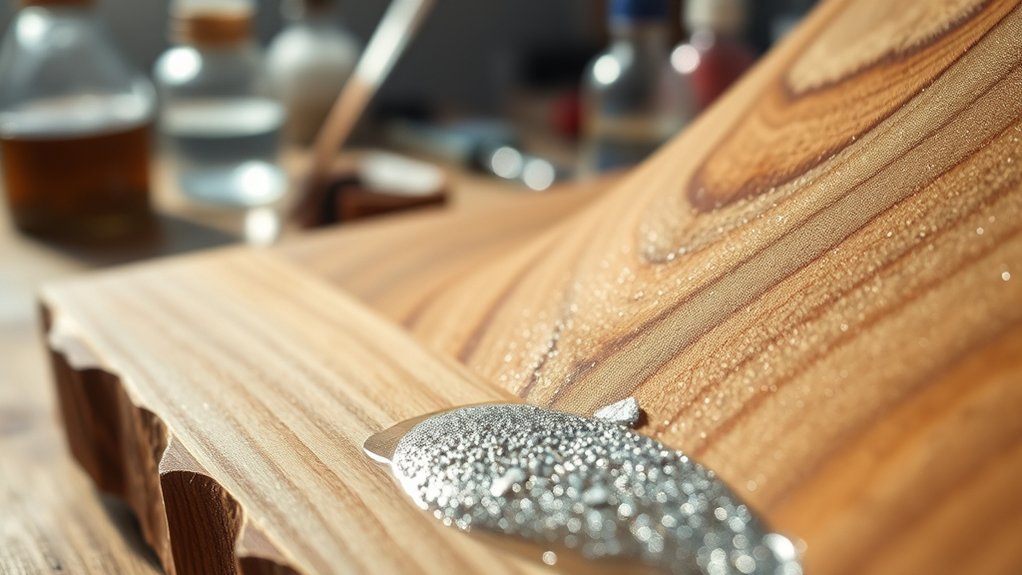
You can considerably enhance wood’s electrical conductivity by applying mineral treatments that introduce free ions into its structure. These treatments, mixed with water, facilitate the flow of electricity by increasing ion availability within the wood’s cellular matrix.
The specific mineral solution used directly affects conductivity levels, enabling you to tailor artistic and scientific outcomes.
Choosing the right mineral solution fine-tunes wood’s conductivity for customized artistic and scientific results.
Wood grain orientation, such as end grain versus side grain, further influences conductivity and resultant pattern formation. By applying controlled voltage, you can create dendrite-like electrification patterns without compromising wood integrity.
Mineral treatments provide essential ions for conduction. Variation in mineral solutions alters conductivity intensity.
Grain structure impacts electrical flow and visual effects. Controlled voltage is critical for preserving wood structure. Electrification generates unique dendritic surface patterns.
This precise manipulation allows wood to become a conductive medium for innovative art and research.
How to Safely Measure Wood’s Electrical Conductivity
When measuring wood’s electrical conductivity, you must first determine its moisture content, as it directly impacts conductivity values. Use the formula MC = ((Wet weight – Dry weight) / Dry weight) × 100 to calculate moisture content.
Next, apply a conductivity meter or multimeter to measure resistance (R), then calculate conductivity (σ) as σ = 1/R. Make sure the wood sample reflects the grain structure accurately, as this affects its capacity to act as a conductor for electrical charge.
Take measurements at different moisture levels to analyze conductivity variations. And always prioritize safety by avoiding high voltages that could cause electrocution.
| Moisture Content (%) | Resistance (Ω) | Conductivity (S) |
|---|---|---|
| 5 | 100000 | 0.00001 |
| 15 | 20000 | 0.00005 |
| 30 | 5000 | 0.0002 |
What Are Practical Uses of Wood’s Conductivity and Insulation?
Although wood generally exhibits low electrical conductivity, it plays a critical role in electrical insulation and safety. Wood is a good insulator because of its dielectric properties and cellular structure. This makes it indispensable for managing electricity safely.
Its moisture content can modulate conductivity, which allows for selective uses in controlled environments.
Consider these practical uses of wood’s conductivity and insulation:
- Electrical paneling and construction insulation to prevent shocks
- Circuit boards utilizing moisture-dependent conductivity
- Insulation of electrical components to avoid short circuits
- Thermal and electrical insulation in building materials
- Artistic applications combining electrified wood for innovative designs
Understanding wood’s dual capacity as a conductor under specific conditions and a robust insulator helps you leverage its unique electrical properties effectively.
Frequently Asked Questions
Can Wood Conduct Electricity Naturally Without Any Treatment?
No, natural wood conductivity is extremely low because wood’s atomic structure limits free electrons, creating high electrical resistance factors.
You’ll find that dry wood acts as an insulator, preventing current flow.
However, if moisture levels rise, ion mobility increases, slightly lowering resistance and allowing some conduction.
What Types of Minerals Are Used to Treat Wood for Conductivity?
You’ll find that common mineral types used for wood conductivity enhancement include sodium chloride, copper sulfate, and ammonium nitrate.
These minerals dissociate into ions, which helps electrical flow within the wood. Treatment methods usually involve dissolving these minerals in water and soaking the wood, allowing the ions to penetrate.
Keep in mind, mineral concentration impacts both conductivity and wood integrity.
Also, the wood species’ grain and moisture content affect how effective the treatment will be.
How Long Does Mineral Treatment Last in Conductive Wood?
Imagine mineral ions weaving through wood fibers like delicate threads in fabric. Mineral longevity typically spans several months to years, depending on treatment effectiveness and environmental factors.
Humidity and temperature influence how well the minerals bond and resist leaching. You’ll want to monitor moisture exposure closely, as it diminishes conductivity over time.
To maintain ideal treatment effectiveness, consider surface sealing and periodic reapplication. This way, your conductive wood performs reliably.
Is Conductive Wood Safe to Use in Household Electronics?
You shouldn’t use conductive wood applications in household electronics without strict adherence to safety standards.
While conductive wood can facilitate electrical flow, its variable moisture content and inconsistent conductivity increase the risk of short circuits and fire hazards.
To guarantee safety, you must monitor moisture levels and conductivity regularly and apply robust insulation.
Without these controls, conductive wood poses significant risks.
Can Conductive Wood Be 3D Printed or Manufactured Artificially?
Yes, you can 3D print conductive wood by integrating conductive materials like carbon nanotubes during the printing process. This artificial conductivity helps improve electron flow by changing the wood’s cellular structure.
Advanced 3D printing techniques give you precise control over conductive pathways. This makes it possible to create complex designs with specific electrical properties.
This method makes it easier to manufacture conductive wood composites that work well for electronics, sensors, and circuits. It’s a great way to combine wood’s natural qualities with engineered electrical functionality.
Conclusion
You might expect wood, a solid and natural material, to conduct electricity like metal, but it doesn’t unless it’s soaked or chemically treated. Ironically, its very structure and moisture content make it invaluable as an insulator. They also render it a poor conductor.
So, if you’re dreaming of wooden wires, think again. Instead, appreciate wood’s unique blend of properties that keep electricity exactly where you want it: contained and controlled.