How Do You Start A Stihl Chainsaw – Startup Guide For Beginners
To start your Stihl chainsaw, first wear all your safety gear and engage the chain brake by pushing the handle forward. Check the fuel and oil levels before you do anything else. Then, set the Master Control Lever to choke if you’re doing a cold start or to the start position if your saw has M-Tronic.
Place the saw firmly on level ground and stabilize it so it doesn’t move. Now, pull the starter cord sharply. If your saw has features like Easy2Start™ or ElastoStart™, use them to make pulling the cord easier.
Follow these steps carefully to get a smooth startup every time. And don’t forget to check out extra tips for troubleshooting and maintenance to keep your saw running great.
Checklist for Chainsaw and Safety Gear Preparation
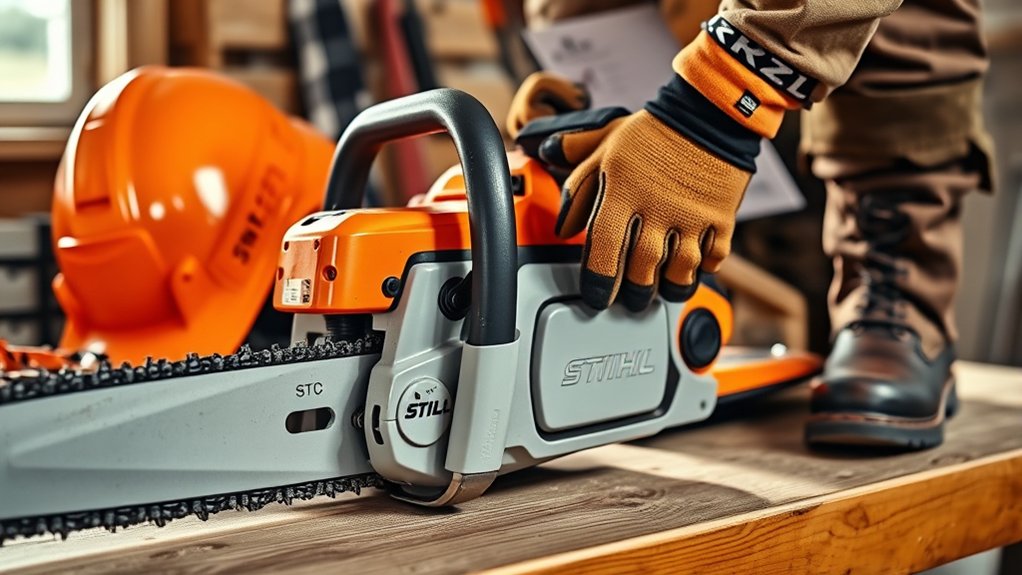
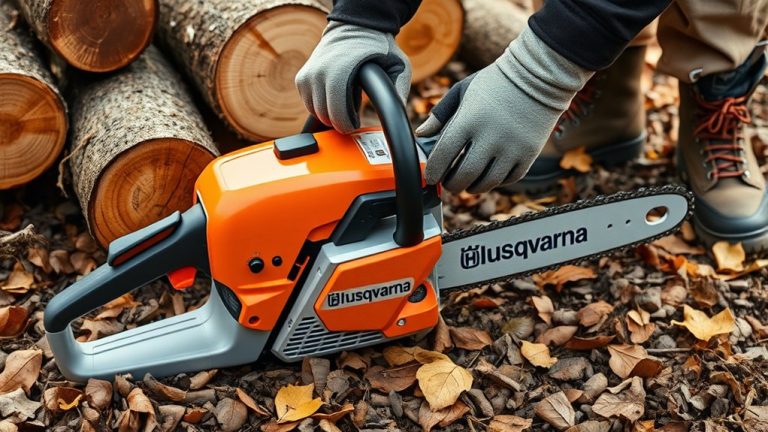
Before you start your STIHL chainsaw, make sure you’re wearing all the necessary safety gear. That means eye and hearing protection, gloves, and chainsaw chaps.
Next, hold the chainsaw firmly with your left hand on the front handle to keep control. Check that the chain is properly fitted, tensioned, and sharpened.
Also, inspect the chain brake to ensure it works, but don’t engage it just yet.
Verify that the bar and chain oil reservoir is full. This helps guarantee smooth operation and prevents overheating.
Confirm the 2-Stroke fuel tank has enough mixed fuel for your task.
Always check the instruction manuals specific to your STIHL model. They’ve detailed safety and operational guidance.
Following this checklist makes sure your chainsaw runs safely and efficiently before you start.
Engage the Chain Brake on Your Stihl Chainsaw
Before you start your Stihl chainsaw, always engage the chain brake. Just push the handle forward to lock the chain in place. This simple step helps prevent the chain from moving accidentally.
It’s important because it keeps you safe during both cold and warm starts.
Also, make sure the chain brake is working properly. That way, you protect yourself from kickback or other hazards while using the saw.
Chain Brake Activation
One essential step in operating your Stihl chainsaw safely is engaging the chain brake by pushing the handle forward prior to starting the engine.
To engage the chain brake, firmly push the chain brake handle forward until it locks in place. This action immobilizes the chain, preventing accidental movement during the starting procedure.
Always familiarize yourself with the chain brake’s function as outlined in the safety and instruction manuals to guarantee proper use.
Before each use, check that the chain brake engages and releases smoothly. When you’re ready to cut, release the chain brake by pulling the handle back toward you.
Proper activation and release of the chain brake are critical for safe chainsaw operation and help maintain control throughout your work.
Taking a moment to get comfortable with these steps makes a big difference in safety and efficiency.
Safety Benefits Explained
Although it might seem like a simple step, engaging the chain brake on your Stihl chainsaw before starting it plays an important role in preventing unintended chain movement and reducing injury risk.
Activating the chain brake by pushing the handle forward locks the chain securely, minimizing the chance of accidental injury during startup. This procedure aligns with safety regulations, including ANSI Standard B175.1, guaranteeing compliance.
The STIHL Quickstop® system enhances this safety by enabling rapid chain braking if needed.
Regularly checking the chain brake’s functionality is vital to maintain a safe operating environment. It’s a small action that makes a big difference when it comes to your safety.
Key safety benefits of engaging the chain brake include:
- Prevents unintended chain movement during startup
- Reduces risk of accidental injury
- Guarantees compliance with safety regulations and enhances safety with STIHL Quickstop
Starting a Stihl Chainsaw Without M-Tronic
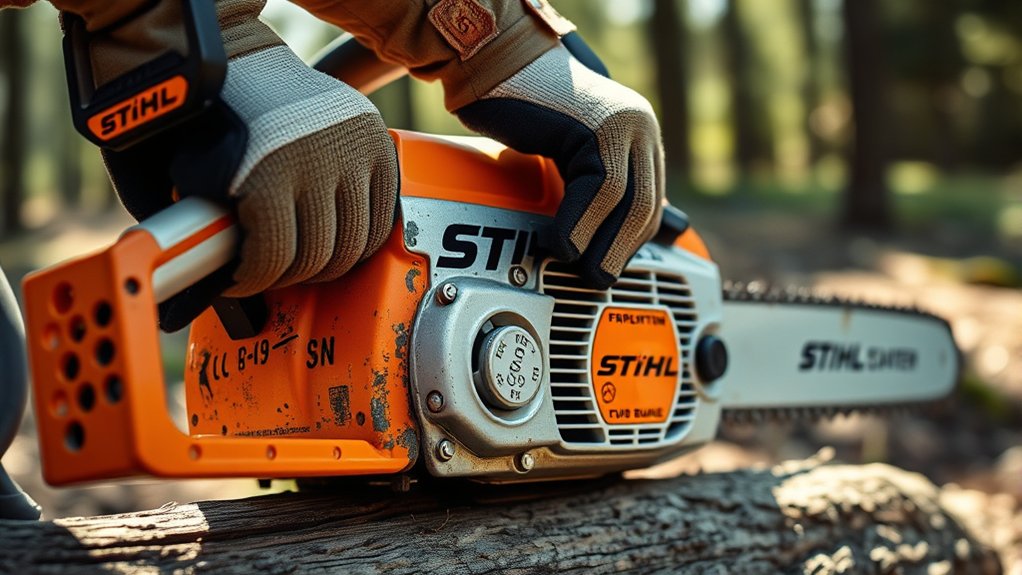
To start a Stihl chainsaw without M-Tronic, first engage the chain brake by pushing the handle forward and remove the bar cover. Then, set the Master Control Lever™ to choke by moving it to the cold start position.
Next, stabilize the saw on level ground. Place your right foot on the rear handle and your left hand on the front handle. Pull the starter cord vertically until you feel resistance, then pull sharply until the engine fires.
If the engine dies, just open the choke and pull again. Always follow safety information and keep your hands clear of the chain.
| Step | Action | Key Point |
|---|---|---|
| 1 | Engage chain brake | Push handle forward |
| 2 | Set Master Control Lever™ | Choke/cold start position |
| 3 | Pull starter cord | Use right foot to stabilize |
Starting a Stihl Chainsaw With M-Tronic
To start a STIHL chainsaw with M-Tronic, first make sure to engage the chain brake.
Then, set the Master Control Lever™ to the start position. If your model has a decompression valve, use it to make pulling the starter cord easier.
Next, pull the starter cord until the engine fires up.
The great thing about M-Tronic is that it automatically adjusts the fuel and ignition settings for peak performance.
This means starting your chainsaw is simpler and reliable, no matter the conditions.
M-Tronic Starting Procedure
Starting a STIHL chainsaw equipped with M-Tronic involves several precise steps to guarantee efficient ignition and safe operation.
First, engage the chain brake and remove the chain guard. Press the decompression valve if your model has one.
Next, set the Master Control Lever™ to the start position (▲) to optimize ignition timing. Place the saw on level ground with the cutting attachment clear and your hands in position.
Pull the starter rope straight until you feel resistance, then pull quickly to start the engine. If it stalls, switch to half throttle and try again.
Key points to remember:
- Always engage the chain brake before starting your chainsaw
- Use the Master Control Lever™ for proper ignition timing
- Pull the starter rope firmly and adjust throttle as needed
Benefits Of M-Tronic
Mastering the M-Tronic starting procedure simplifies your interaction with the chainsaw by automatically adjusting fuel and ignition timing according to environmental conditions. You only need one position on the combi-lever for both cold start and hot start, eliminating manual choke adjustments. This reduces flooding the engine and enhances reliability during startup.
The system guarantees peak engine efficiency, delivering consistent maximum speed and acceleration without your intervention. M-Tronic makes the chainsaw user-friendly, especially for beginners.
| Benefit | Description |
|---|---|
| One Position Start | Simplifies starting with a single combi-lever position |
| Cold Start Handling | Automatically adjusts for cold and hot starts |
| Flooding Prevention | Reduces risk of flooding the engine |
| Enhanced Performance | Enhances fuel and ignition timing for max speed |
Using STIHL Easy2Start™ and ElastoStart™ for Easier Starting
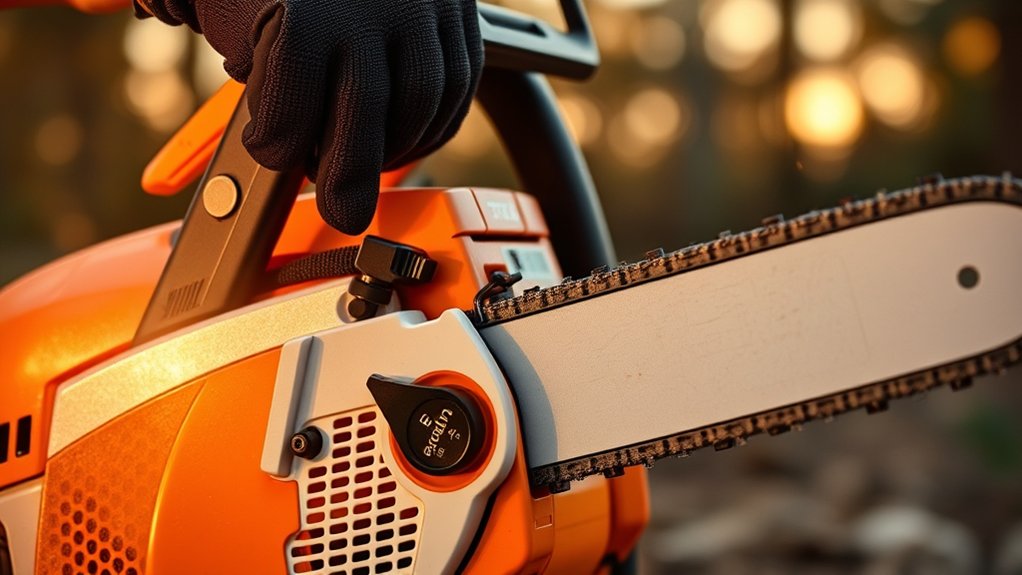
Although pulling a chainsaw cord can be challenging, STIHL’s Easy2Start™ and ElastoStart™ technologies make the process a lot smoother and easier to handle.
STIHL Easy2Start reduces the force you need to pull during starting. At the same time, ElastoStart’s shock absorber grip cuts down on jerking motions, which makes it more comfortable and safer to use.
STIHL Easy2Start lowers pull force, while ElastoStart’s grip minimizes jerks for safer, more comfortable starts.
When you start your chainsaw, keep the starter cord straight and use the manual fuel pump as instructed. You’ll feel some resistance before the engine fires up, which means everything is working properly.
Here are a few key points to remember:
- Use STIHL Easy2Start to cut down on pull force and effort.
- ElastoStart helps absorb shock, so you get better control and safety.
- And always follow the product safety and instruction guidelines for the best results.
If you want to get the most out of these features, be sure to consult your STIHL dealer for a demonstration.
Starting a Stihl Chainsaw on Uneven Ground
When you need to start a STIHL chainsaw on uneven ground, make certain you clear debris and establish a stable footing to maintain control and prevent slipping. Position the rear handle against your leg for added stability. Hold the handlebar firmly with your left hand, locking your elbow to reduce strain.
Engage the chain brake by pushing the handle forward before pulling the starter rope vertically. Avoid pulling near gravel or masonry to prevent debris hazards. Verify the cutting attachment is clear and have a safe escape route ready.
| Step | Action |
|---|---|
| 1 | Clear debris and find stable footing |
| 2 | Position rear handle against your leg |
| 3 | Engage chain brake with handle |
| 4 | Pull starter rope vertically until engine fires |
How to Start Your Electric Stihl Chainsaw Safely
Starting an electric STIHL chainsaw requires a bit different prep compared to a gas-powered model, especially if you’re working on uneven ground. First, make sure your STIHL chainsaw is connected to a proper power source with the right voltage. Always wear protective gear before you move the master control to the start position.
Next, engage the safety features by pulling the hand guard toward the handle until it clicks. You don’t need to press the primer on an electric model, so you can skip that step. Once you’re ready, release the chain brake by pushing it forward to free the chain.
Before you power on, double-check that your footing is stable and the area around you is clear. It’s all about staying safe and making sure nothing gets in the way while you work.
Connect to a suitable power supply with an appropriate extension cord. Wear full protective gear, including safety glasses and gloves. Engage safety features and release the chain brake before starting.
Troubleshooting Common Starting Problems
If your STIHL chainsaw refuses to start, begin by checking the fuel levels and verifying you’re using the correct fuel-to-oil ratio for two-stroke engines.
Make sure the chain brake is engaged by pushing it before you start your chainsaw, as some models won’t start otherwise.
Engage the chain brake before starting your chainsaw, as some models require it to start properly.
Inspect the air filter and spark plug for clogs or damage. If the engine floods, pull the starter cord with the choke open to clear excess fuel.
Use the decompression valve if your model has one to ease starting.
Release the throttle trigger lockout and guarantee the throttle trigger moves freely.
Once started, let the chainsaw run at normal idle.
Always refer to your instruction manual for model-specific troubleshooting tips and maintenance procedures to guarantee reliable operation.
Frequently Asked Questions
How Often Should I Replace the Chainsaw Chain?
You should replace your chainsaw chain after 3-5 chain sharpening sessions or when you notice excessive chain wear that affects cutting efficiency.
Regularly check chain tensioning and lubrication to maintain performance and safety.
If the chain shows damaged teeth or requires more force despite proper cutting techniques, it’s time for replacement.
Follow safety precautions during inspection and replacement.
For frequent or heavy-duty use, consider an annual replacement frequency to guarantee peak operation.
Keeping an eye on your chain will help you avoid surprises and keep your saw working smoothly.
What Type of Fuel Mixture Is Best for My Stihl Chainsaw?
You should always use a 50:1 mixing ratio of high-quality synthetic 2-stroke oil to unleaded gasoline with an octane level of 89 or higher for peak performance.
Fuel types with over 10% ethanol can harm engine longevity, so avoid them.
Prepare fresh mixtures monthly and consider fuel storage with stabilizers to maintain fuel quality.
Proper fuel handling directly impacts your Stihl chainsaw’s performance and engine lifespan.
Taking good care of your fuel mix really pays off by keeping your chainsaw running smoothly for a long time.
How Do I Properly Maintain the Chainsaw’s Air Filter?
To properly maintain your chainsaw’s air filter, perform regular air filter cleaning by removing dirt and debris.
For foam filters, wash with soapy water, dry, then re-oil. Paper filters require replacement following the filter replacement frequency recommended in your manual.
It’s important to address common air filter issues like clogging to maintain airflow. Good airflow is vital for peak chainsaw performance.
Always check that the air filter is correctly seated to prevent unfiltered air from damaging the engine.
Can I Use My Stihl Chainsaw in Wet or Rainy Conditions?
You’ll want to avoid using your Stihl chainsaw in soggy conditions to sidestep moisture effects that can hamper engine performance and create electrical hazards, especially with electric models.
Prioritize safety precautions by ensuring the air filter and spark plug stay dry, and adjust handling techniques to maintain stable footing.
Keep up with blade maintenance, as wet environments reduce cutting efficiency.
After use, thoroughly dry your chainsaw to preserve its reliability and longevity. It’s just a smart way to keep your tool working well for a long time.
What Are the Signs That My Chainsaw Needs Professional Servicing?
You need professional servicing if you notice chainsaw performance issues like difficulty starting, smoking exhaust, or excessive vibrations.
Watch for chain wear signs and unusual noises such as grinding or rattling during operation. Fuel leakage is another critical indicator.
Ignoring these symptoms can worsen damage, so have a qualified technician inspect your chainsaw promptly to maintain safety and efficiency.
It’s better to get it checked early than to deal with costly repairs later. Keeping your chainsaw in good shape helps it run smoothly and keeps you safe while working.
Conclusion
Now that you know how to start your Stihl chainsaw safely and efficiently, remember proper preparation is key. Did you know that nearly 60% of chainsaw accidents happen during startup because of improper handling? By following these steps, like engaging the chain brake and using the right starting method for your model, you’ll reduce risks and guarantee smooth operation every time.
Also, don’t forget to wear your safety gear. It really makes a difference. Stay cautious, stay prepared, and keep your chainsaw running at peak performance.