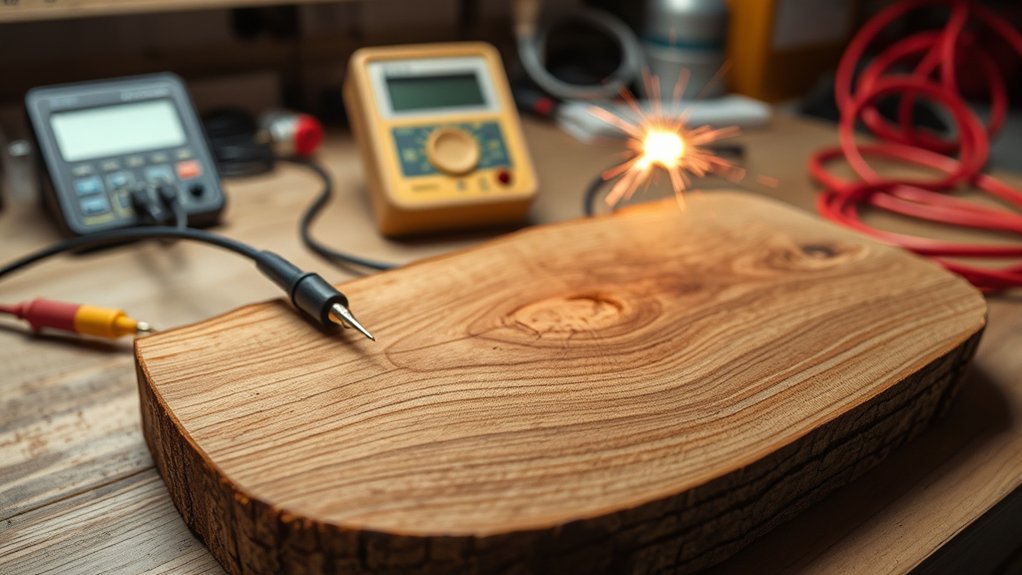
Can Electricity Travel Through Wood: Scientific Explanation And Facts
Electricity can travel through wood, but only when it contains moisture. Dry wood lacks free electrons and acts as a strong insulator. However, water within wood enables ion movement, which allows electrical conduction.
The conductivity varies depending on the moisture level, wood species, and fiber orientation. Wet or saturated wood can conduct electricity similarly to weak metals. Chemically modifying wood can make it even more conductive.
It’s important to understand these factors for safety and practical uses involving wood and electricity. Exploring this topic reveals some pretty interesting details about how wood behaves with electricity.
Key Takeaways
- Dry wood is an electrical insulator due to minimal free electrons and low moisture content preventing electrical conduction.
- Moisture in wood enables ion movement, allowing electricity to travel through wet or saturated wood.
- Wood’s electrical conductivity varies by species, moisture level, grain orientation, and mineral impurities in sap or water.
- Chemical treatments like lignin removal and nanoparticle incorporation can enhance wood’s electrical conductivity significantly.
- Wet wood near electrical sources poses shock hazards, so safety precautions are essential to avoid electric accidents.
How Does Wood Conduct Electricity?
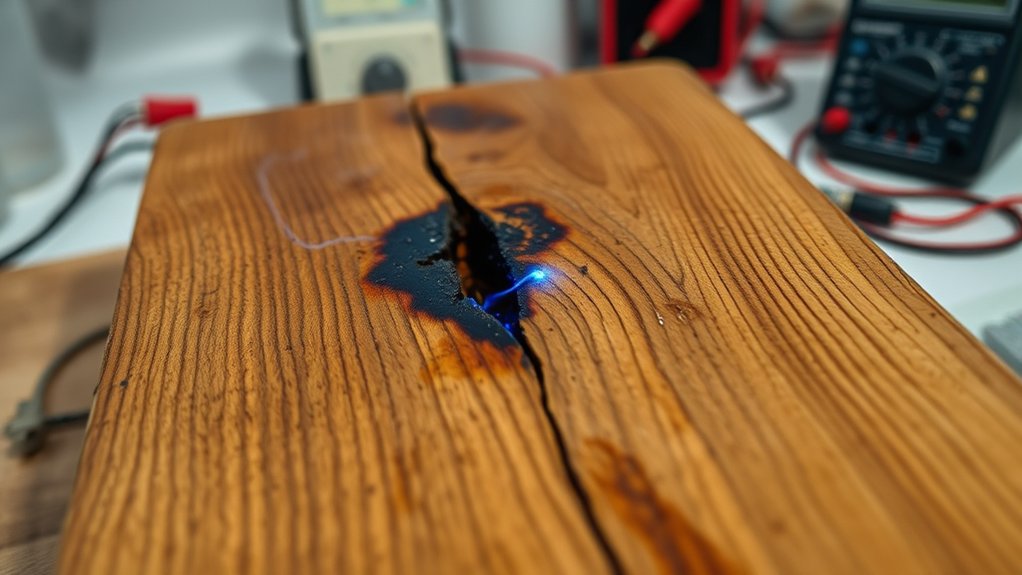
How exactly does wood conduct electricity despite being known primarily as an insulator? Wood’s structure, composed mainly of lignin and cellulose, lacks free electrons, which limits its intrinsic electrical conductivity.
However, electrical conductivity in wood can occur because of the moisture content within its cellular structure. Water molecules present in wood help move ions around, which allows the material to conduct electricity under certain conditions.
The degree to which wood conducts electricity depends on factors like moisture content, wood species, and fiber orientation. At the nanoscale, electron hopping between cellulose molecules has been observed. This suggests that there’s limited electron mobility within the wood matrix.
How Does Moisture Affect Wood’s Electrical Conductivity?
You’ll notice that moisture content directly impacts wood’s electrical conductivity because it allows ions to move within the wood’s structure.
Conductivity doesn’t just depend on how wet the wood is; it also changes based on the type of wood and the minerals dissolved in the water.
Unlike dry wood, which acts like an insulator, wet wood can actually conduct electricity.
This means that when wood gets wet, it can create safety risks in certain situations.
Moisture Content Impact
Although wood is generally an electrical insulator, its conductivity increases considerably as moisture content rises because water molecules enable ion movement within the wood’s cellular structure.
When you encounter wet wood, the elevated moisture content facilitates electrical conduction by providing a medium for ions to travel, greatly enhancing conductivity compared to dry wood.
In fact, saturated wood can conduct electricity at levels comparable to weaker metals under specific conditions. You should also note that mineral impurities dissolved in the moisture further improve conduction by creating additional ionic pathways.
For example, engineered woods like soaked balsa exhibit up to ten times greater electrical conduction than natural wood due to increased moisture and altered structural properties.
Conductivity Variation Factors
Since moisture fundamentally alters the ionic environment within wood, it directly affects electrical conductivity by enabling charged particles to move through the material’s cellular matrix.
The conductivity variation you observe depends heavily on the moisture content, as water introduces ions that carry electrical charge through the wood.
When moisture content rises, these ions facilitate conduction, transforming wood from an insulator to a more conductive medium.
However, this effect varies with wood species, grain orientation, and the composition of cellulose, lignin, and hemicellulose, which influence ion mobility and charge distribution.
For example, balsa wood exhibits significant conductivity increases when soaked due to its cellular structure.
Wet Versus Dry
Understanding how moisture changes wood’s electrical conductivity requires comparing its behavior in wet and dry states.
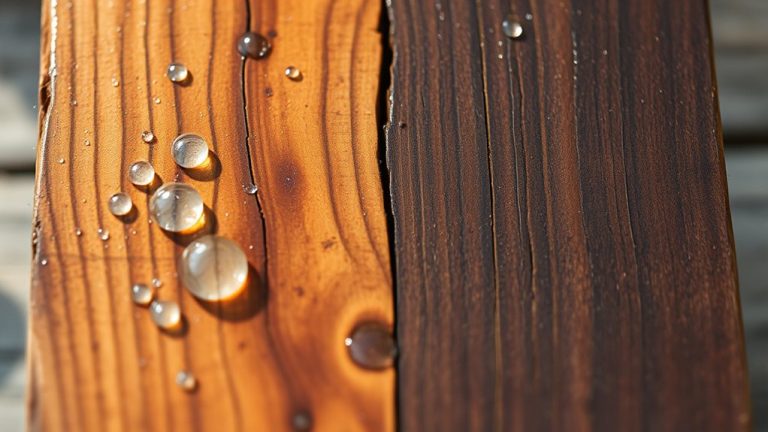
Wet wood exhibits considerably higher conductivity because the moisture contains ions that facilitate electrical current flow. In contrast, dry wood lacks free electrons and has high resistance, making it an effective insulator that largely prevents electricity from passing through.
Even slight moisture increases conductivity, showing how environmental conditions can impact wood’s electrical properties.
When you handle electrical systems near wood, recognizing that wet wood poses a greater shock hazard than dry wood is critical. This difference arises because moisture lowers resistance, enabling current to travel more easily.
So, it’s really important to evaluate the moisture content for accurate conductivity evaluation and to ensure electrical safety around wooden materials.
Keeping an eye on this can make a big difference in preventing accidents.
Can Dry Wood Conduct Electricity?
How well can dry wood conduct electricity? Dry wood acts as an excellent insulator because its cellular structure, rich in cellulose and lignin, lacks free electrons necessary for electrical conduction.
Unlike wet wood, which contains moisture facilitating ion transport and considerably enhancing conductivity, dry wood’s electrical conductivity is negligible.
As wood dries, its moisture content drops, reducing its ability to carry electric current dramatically. As a result, you should consider dry wood an effective barrier to electricity under normal conditions.
However, it’s important to remember that if dry wood becomes wet or exposed to high humidity, its insulating properties decline. This increases electrical conductivity and the risk of shock.
How Does Wood’s Structure Affect Its Electrical Conductivity?
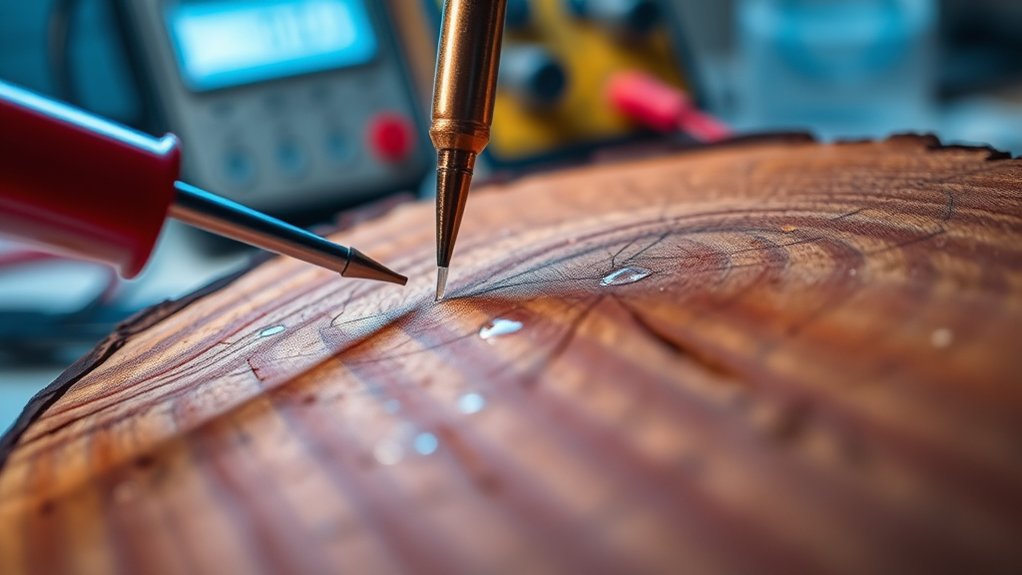
You’ll find that wood’s cellular makeup, which is mainly cellulose and lignin, actually restricts the free flow of electrons, so its conductivity is pretty limited.
But here’s the interesting part: when wood has moisture, the water introduces ions that really boost electrical transport.
On top of that, the way the wood fibers are oriented makes a difference too. For example, when the fibers are aligned horizontally, it often helps electrons move more easily.
Cellular Composition Impact
Wood’s cellular composition directly governs its electrical conductivity by limiting free electron movement within its matrix. It’s mainly made up of cellulose, hemicellulose, and lignin, which together form a dense structure that naturally restricts charge carriers. This is why wood acts as an effective insulator.
The orientation of wood fibers also plays a role. Horizontally aligned fibers tend to slightly boost electron mobility compared to vertical alignment. While moisture content has a big impact on conductivity, here we’re focusing on the wood’s intrinsic cellular architecture.
Interestingly, chemical treatments that remove lignin change the cellular makeup. This increases ion transport pathways and improves electrical properties.
Plus, nanofibers inside wood resemble carbon nanotubes, which expand the surface area for charge storage and give conductivity a bit of a boost.
Getting a good grasp on these cellular factors is key if we want to push wood’s use further in new electronic materials.
Moisture Content Role
Although the intrinsic cellular structure sets a baseline for electrical conductivity, moisture content plays a decisive role in altering how well wood can conduct electricity. Water within wood acts as an effective medium for electric current due to its ion-rich nature, considerably enhancing conductivity.
When wood’s cellulose matrix absorbs moisture, it facilitates ion transport, allowing charged particles to move more freely, thereby increasing electrical flow.
You’ll notice dry wood exhibits minimal conductivity, functioning fundamentally as an insulator. Conversely, as moisture content rises, the conductivity can escalate dramatically, enabling wood to carry measurable electric currents under specific conditions.
Understanding this relationship is critical since moisture retention varies among wood types and influences conductivity. This directly impacts wood’s performance in electrical applications and safety considerations.
Fiber Orientation Effects
Because the orientation of fibers dictates the paths available for electron movement, electrical conductivity varies a lot depending on whether the fibers run horizontally or vertically.
You’ll find that horizontal fiber orientation helps charge move more easily because the pathways align and reduce resistance to electron flow. Wood’s anisotropic nature means that electrical conductivity depends on direction, with grain alignment playing a big role in ion diffusion coefficients and, as a result, conductivity.
When fibers line up uniformly, charge transfer becomes more efficient, which is super important for energy applications involving wood.
Understanding these fiber orientation effects lets you optimize wood-based electronic devices by adjusting grain direction to get the best electrical performance.
How Is Wood’s Electrical Conductivity Enhanced by Modification?
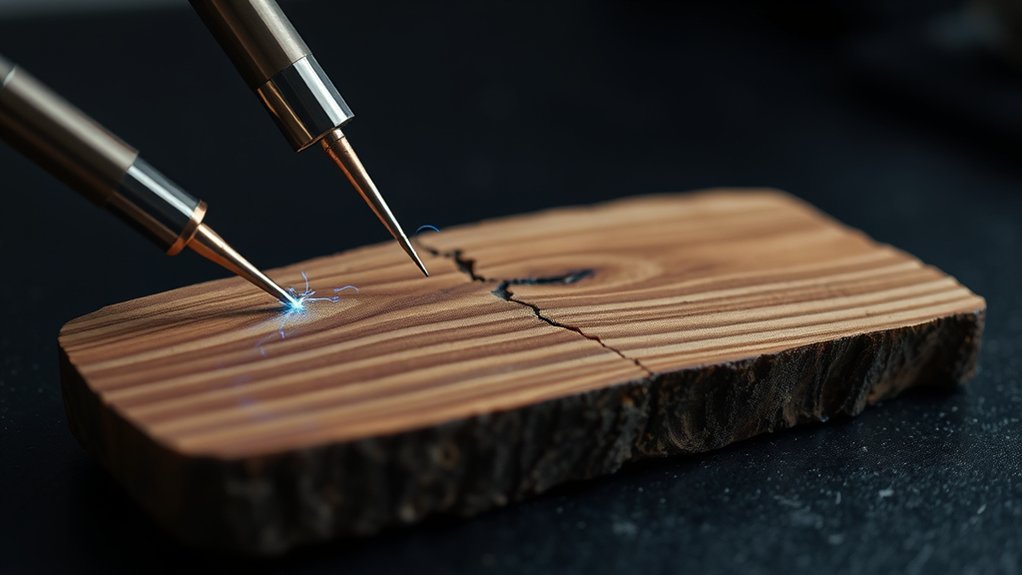
When you chemically modify wood by removing lignin through treatments with agents like sodium hydroxide and sodium sulfite, you increase the cellulose surface area, which greatly enhances electrical conductivity. These modifications improve charge storage and facilitate more efficient charge transfer within the wood matrix.
For instance, delignified wood exhibits enhanced piezoelectric properties, generating higher electrical output under mechanical stress. Furthermore, soaking engineered balsa wood greatly boosts conductivity, producing up to ten times more electricity than untreated wood.
Incorporating iron oxide nanoparticles into modified wood further amplifies power output by a factor of 165, showing how nanotechnology and chemical treatments work together.
In addition, copper ion infusion in delignified wood promotes lithium ion transport, indicating potential applications in flexible wood-based solid electrolytes and batteries.
These precise modifications strategically optimize wood’s electrical properties. It’s pretty amazing how tweaking the wood at a chemical level can make such a big difference in its electrical performance.
What Natural Electrical Phenomena Occur in Living Trees Related to Wood Conductivity?
While living trees might seem passive, they actively generate various natural electrical phenomena linked to wood conductivity. The sap flow within the xylem creates electric potentials, influenced by diurnal pressure variations and stomatal activity. This streaming potential is essential for understanding tree-environment electrical interactions.
Furthermore, fungal degradation enhances wood’s piezoelectric properties by altering its structure, increasing its electrical responsiveness. The conductivity of green wood fluctuates markedly depending on moisture content, grain orientation, and ionic presence. These factors directly affect its ability to conduct electricity.
Fungal decay boosts wood’s piezoelectricity, while moisture, grain, and ions modulate its electrical conductivity.
In addition, trees induce perturbations in local atmospheric and soil electric fields, showing their integral role in terrestrial electrical dynamics.
Understanding these phenomena reveals how living trees contribute to and interact with natural electrical systems through their wood’s inherent conductivity.
How Is Electricity Used in Wood Processing and the Timber Industry?
Although wood is a natural insulator, the timber industry harnesses its electrical properties in several innovative ways to optimize processing and quality control. By exploiting how electricity travels through wood, especially its electrical conductance when wet, professionals improve drying efficiency and detect decay.
Technologies like electro-osmotic flow accelerate moisture removal, while electric heating uses wood’s dielectric properties for rapid pre-drying. Plus, streaming potentials help with timber quality mapping by evaluating internal sap flow and electrical characteristics.
| Application | Electrical Property |
|---|---|
| Electro-osmotic flow | Moisture removal |
| Electric heating | Dielectric properties |
| Quality mapping | Streaming potentials |
| Decay detection | Electrical conductance |
Understanding these properties of wood lets people have precise control in timber processing and structural assessment. It makes the whole process more efficient and reliable.
Safety Tips for Using Electricity With Wood
Since wood’s electrical properties vary a lot depending on how much moisture it has, you need to be really careful when working with electricity around wood.
Wet wood can conduct electricity because of the water and minerals inside it, which makes electrical hazards much more likely.
To stay safe, follow these tips: Always avoid touching wet wood near electrical gear. It can act like a conductor and give you a shock.
Also, wear insulated shoes, like rubber-soled ones, to reduce the chance of electricity passing through your body.
And if you’re dealing with treated or chemically modified wood, it’s best to check with a professional first. Treatments can change how the wood conducts electricity and affect safety.
Frequently Asked Questions
Can Wood Generate Electricity on Its Own Without External Sources?
No, wood can’t generate electricity on its own without external sources. Its natural wood properties include high electrical resistance, which prevents free electron flow.
While wood contains natural sources like moisture and organic compounds, these don’t produce usable electrical currents independently.
You’d need mechanical stress or chemical modifications to overcome this resistance and induce electric charge.
So, without external influence, wood remains an electrical insulator rather than a generator.
Basically, wood just doesn’t have what it takes to create electricity by itself.
What Types of Wood Are Best for Electrical Conductivity?
When it comes to wood species comparison, softwoods like pine and spruce steal the show in conductivity testing, thanks to their higher moisture content and less dense structure.
You’ll find balsa wood also performs well because its cellulose structure aids electron movement. For practical applications, these woods offer better electrical conductivity than hardwoods.
Remember, grain orientation and chemical modifications can further influence how well electricity travels through wood.
How Does Temperature Influence Electricity Flow Through Wood?
Temperature effects considerably influence electricity resistance in wood by altering its moisture content. As you increase temperature, wood moisture tends to decrease due to evaporation, which raises resistance and reduces conductivity.
However, moderate temperature rises can enhance ion mobility within the wood’s cellular structure, lowering resistance when moisture is sufficient.
You have to keep in mind that excessive heat can degrade wood, disrupting pathways for electricity flow. This damage ultimately increases resistance over time.
Are There Environmental Benefits to Using Wood-Based Electrical Materials?
Imagine traditional metals polluting landscapes while wood-based materials grow quietly in forests. You benefit environmentally by choosing wood’s sustainable sourcing, which lowers your carbon footprint considerably compared to mining metals.
Wood-based electrical components also enhance energy efficiency through biodegradable, engineered designs. This helps reduce waste and pollution.
Can Wood-Based Electronics Be Recycled or Biodegraded Safely?
Yes, you can safely recycle or biodegrade wood-based electronics using advanced wood recycling methods and biodegradable alternatives.
These methods involve treating wood with non-toxic chemicals and removing lignin biologically, which minimizes environmental impact.
By employing biodegradable polymers and eco-friendly processes, you guarantee that electronic components break down without releasing toxins.
This approach supports sustainable waste management and reduces harmful residues compared to conventional electronic materials.
It’s a smart way to keep our planet cleaner while still enjoying modern technology.
Conclusion
You’ve seen that dry wood barely conducts electricity, but add moisture, and it becomes a different story. For instance, a utility worker once experienced a shock while handling a wet wooden pole during a storm, illustrating wood’s increased conductivity when damp.
Understanding wood’s structure and moisture content helps you predict electrical behavior and apply safety measures efficiently. Always treat wood with caution around electricity to prevent accidents and guarantee safe operations.