
Where Can I Get Wood Cut to Size? Detailed Guideline
You can get wood cut to size at local lumber yards, specialty shops, home improvement stores, or through online retailers. Lumber yards and specialty shops offer precise, custom cuts with various wood options. Home stores usually provide limited free cuts on standard lumber.
Online services deliver pre-cut wood tailored to your measurements. Always measure carefully and factor in blade kerf. Want to guarantee perfect cuts, understand wood types, and avoid waste? Keep exploring for practical tips and detailed guidance.
Local Lumber Yards Offering Wood Cutting
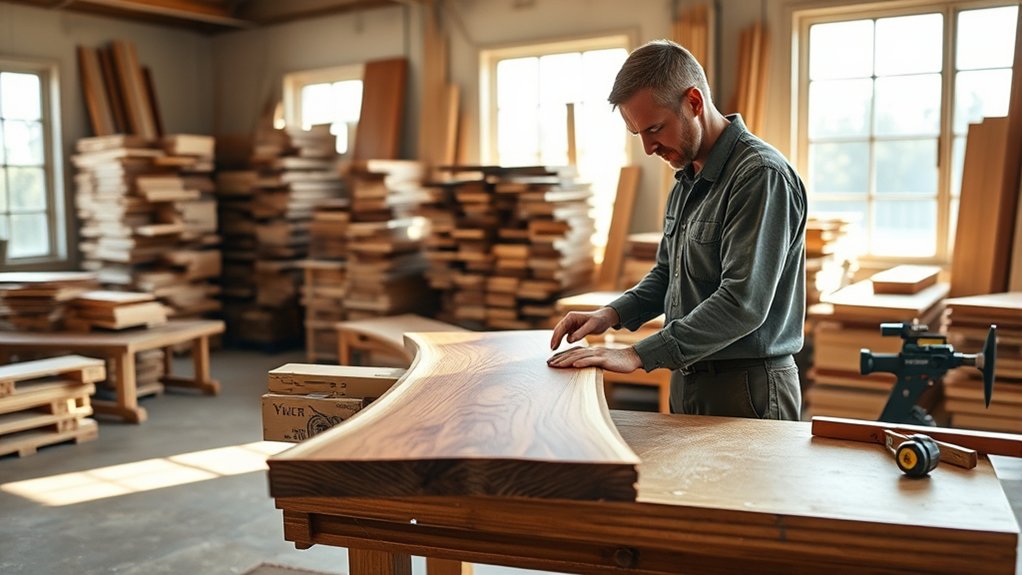
If you need wood cut to specific dimensions, local lumber yards are a reliable place to start. These yards often provide wood cutting services, allowing you to get precise, custom-sized pieces tailored for your project.
Skilled staff typically assist with cutting, ensuring accuracy and high-quality results. Local lumber yards offer a variety of wood species and types, so you can select materials that meet both aesthetic and functional needs.
Expert staff provide precise cuts while offering diverse wood options to suit your project’s style and function.
While some may charge a fee for cutting, this service can save you significant time and reduce waste compared to DIY cutting.
Before visiting, call ahead to confirm if cutting services are available and check any limitations. Not all local lumber yards provide this option or they may have specific restrictions, so it’s good to know before you go.
Wood Cutting at Home Improvement Stores
Home improvement stores often offer on-site cutting services for standard lumber and sheet goods. Usually, they allow two or three free cuts per board, which is pretty handy.
Just keep in mind that some cuts might be a bit rough, so you may need to do some extra finishing at home.
Also, if you need more than the free cuts, there’s usually a fee for the additional ones.
It’s a good idea to measure carefully before you ask for cuts because most stores don’t accept returns on wood that’s already been cut.
Available Cutting Services
Many improvement stores provide wood cutting services that let you customize lumber lengths and widths right on-site. These cutting services often come free or at a low cost, but you should verify fees with your specific store.
They generally handle standard cuts, so prepare your measurements carefully, as intricate or custom cuts may not be available. To get the most accurate results, bring a clear list of cuts and precise dimensions.
Be aware that wait times can vary, especially during busy hours, since staff balance multiple tasks and customers. Planning ahead and knowing your exact requirements will help you use these cutting services efficiently, saving time and avoiding mistakes.
This convenience makes home improvement stores a practical choice for straightforward wood cutting needs. So, if you’ve got simple cuts in mind, these services can be a real time-saver.
Just double-check what your store offers before you go.
Limitations And Accuracy
While on-site wood cutting services offer convenience, they come with certain limitations you should keep in mind. Home improvement stores typically cut standard dimensional lumber but may not handle specialty hardwoods like a lumber yard would.
Their accuracy often isn’t precise to the millimeter, which can be a problem for custom or intricate projects. Also, cuts usually follow standard sizes, potentially leading to wasted material if you need specific dimensions.
Keep in mind the blade kerf, about 1/8 inch, which affects your final measurements. During busy times, you might face longer wait times since staff juggle multiple tasks.
For projects demanding high precision or specialty wood, consider a lumber yard, where cutting services tend to be more accurate and flexible. It’s usually worth the extra effort if you want the job done right.
Custom Wood Cutting at Specialty Shops

If you need wood cut to exact specifications, specialty shops offer tailored services that cater directly to your project’s demands. They excel in custom wood cutting by combining expertise and advanced technology to deliver precision and quality.
When working with these shops, you can expect access to a broad selection of wood species for the ideal aesthetic and functional fit. They use cutting-edge equipment for highly accurate cuts.
Specialty shops offer diverse wood choices and precision cutting with advanced technology for perfect results.
Plus, some even offer online configurators so you can visualize and customize your order in real time. You’ll also find additional finishing options like sanding, giving you a ready-to-use product right away.
Another great thing is that precise cutting techniques help minimize material waste, which is better for your budget and the environment.
Online Retailers for Pre-Cut Wood
Specialty shops offer precise, custom wood cutting, but online retailers bring this convenience straight to your door. Many online retailers provide custom cutting services where you specify exact dimensions and order pre-cut wood tailored to your project.
These platforms often include real-time visualization tools so you can see your wood cuts before finalizing your purchase, ensuring accuracy.
You’ll find a wide variety of wood species, over 13 types, suitable for everything from worktops to shelving. Plus, many online retailers source wood sustainably, using FSC® and PEFC™ certified materials.
To make larger orders more cost-effective, some offer free shipping on purchases above €350.
Choosing online retailers lets you combine precision, variety, and eco-friendly options with the ease of home delivery. It’s a smart way to get exactly what you need without leaving the house.
Preparing a Detailed Cut List for Wood Cutting
C:\Users\user\Downloads\zimmwriter\output\Where_Can_I_Get_Wood_Cut_to_Size_Detailed_Guideline_0003.jpg
Creating a detailed cut list is essential to guarantee you order the right materials and minimize waste. Your cut list should clearly specify the dimensions and quantities of all pieces, helping you select materials precisely.
Don’t forget to factor in kerf allowance, the saw blade’s thickness, to avoid sizing issues. To keep things efficient, group similar sizes and types together. You might also find a cut list optimizer tool invaluable. It tests cutting layouts and shows visual diagrams to maximize material use.
Finally, always double-check actual lumber dimensions since they often differ from nominal sizes. Here’s what to focus on for your cut list:
- Include precise dimensions and quantities
- Account for kerf allowance
- Group similar sizes and materials
- Use cut list optimization tools
- Verify actual lumber measurements
Nominal vs. Actual Wood Sizes: What You Need to Know
When you buy lumber labeled as a 2×4, it’s good to know that the actual size is usually about 1.5” by 3.5” once it’s been dried and planed.
See, these nominal sizes are the rough cut dimensions before the wood gets finished, so the finished piece often ends up smaller than you might expect.
Knowing this difference can really help you plan better and avoid those costly mistakes when you’re getting wood cut to size.
It’s one of those little details that makes a big difference in your project!
Nominal Size Explained
Understanding lumber dimensions starts with knowing the difference between nominal and actual sizes. Nominal sizes refer to the dimensions before drying and finishing, so they’re usually larger than what you get after processing.
For example, a “two by four” (2×4) is nominal, but its actual size is about 1.5 by 3.5 inches.
Keep these points in mind about nominal sizes:
- Nominal sizes represent rough-cut lumber dimensions.
- Common thickness terms like 4/4 mean 1 inch thick.
- Actual sizes shrink due to drying and planing.
- Finished lumber dimensions are always smaller than nominal.
- Knowing these differences helps you avoid ordering errors and project delays.
Finished Dimension Variations
Although lumber is commonly sold by its nominal size, you’ll find that the finished dimensions are smaller due to drying and planing processes. For instance, a nominal 2×4 actually measures 1.5” x 3.5” once dried and planed. This reduction happens because drying reduces moisture, shrinking the wood, and planing smooths the surfaces, further trimming the size.
When you select lumber, note that rough cut pieces, like 4/4 thickness, are thicker but unfinished. S4S lumber is planed on all four sides, giving you precise finished dimensions. Understanding these differences is essential.
If you don’t account for finished dimensions, your project measurements can be off, leading to costly mistakes. Always verify actual sizes before cutting or assembling your wood projects.
What to Expect: Quality, Pricing, and Services From Wood Cutters
Since you want quality cuts without overpaying, wood cutters offer competitive pricing that often beats market averages by charging only for the materials you need, eliminating waste.
Get precise wood cuts at competitive prices by paying solely for the materials you require, cutting down on waste.
You can expect precision cuts backed by craftsmanship rooted in family sawmill tradition. This ensures durability and flawless finishes.
Services typically include access to over 13 solid wood species for tailored projects, planing and sanding for smooth, ready-to-use surfaces, and eco-friendly wood from FSC® and PEFC™ certified forests.
You can also enjoy 100% online ordering with real-time project visualization.
Plus, there’s free home delivery on orders above €350.
This combination of quality, pricing, and extensive services means you get both value and reliability when sourcing wood cut to size.
Essential Tips to Measure and Verify Wood Cuts
Accurate measurements form the foundation of successful wood cutting, so always measure twice before making any cuts. Use a quality tape measure and a story stick to keep measurements consistent across all pieces.
Remember, the actual dimensions of lumber can differ from nominal sizes due to drying and finishing, so verify your measurements carefully.
Also, account for the kerf, the thickness of the saw blade, when planning cuts, as it impacts the final size of each piece. Mark your wood with a carpenter pencil or lumber crayon to track measurements and grain direction. This helps ensure both precision and aesthetic consistency.
Finally, cross-check all measurements against your cut list to minimize waste and confirm you have every piece needed for your project. This methodical approach guarantees accuracy and efficiency in your wood cutting.
It really makes a difference!
Frequently Asked Questions
What Types of Wood Are Best for Outdoor Projects?
For outdoor projects, you’ll want wood with strong durability to withstand weather and pests.
Pressure-treated lumber offers excellent wood durability at a budget-friendly price. Cedar and redwood resist moisture naturally, giving you both durability and beauty.
If you prefer low maintenance, composite materials are a solid choice.
For high-end durability, tropical hardwoods like teak or mahogany work great, though they’re pricier.
Always look for FSC® or PEFC™ certified wood to guarantee sustainability.
It’s a smart way to make sure your project is eco-friendly and responsibly sourced.
How Do I Safely Transport Large Wood Pieces?
To safely transport large wood pieces, use strong transport techniques like securing them tightly with straps or ropes to prevent shifting.
Add padding between the wood and your vehicle to avoid scratches.
If pieces extend beyond your vehicle, mark the ends with a flag for visibility.
Distribute weight evenly, keeping heavier pieces near the center.
When using a roof rack, confirm it supports the load and secure the wood properly to avoid accidents.
Taking these steps will help keep your wood and vehicle safe during transport.
Can Wood Be Cut Into Non-Standard Shapes or Curves?
Yes, you can get wood cut into non-standard shapes or curves through custom shaping services. These services use advanced tools like CNC routers and band saws to create precise, intricate designs tailored to your project.
You’ll often find design configurators that let you specify unique dimensions and contours.
To guarantee accuracy, provide detailed drawings or templates. This way, your wood pieces meet exact specifications for furniture, cabinetry, or artistic woodworking projects.
It’s pretty cool how these tools let you bring even the most creative ideas to life!
What Tools Should I Have for Minor Wood Cutting at Home?
You absolutely need to arm yourself with essential tools for minor wood cutting at home! Grab a reliable handsaw for precise cuts, a miter box for perfect angles, and a jigsaw for creative curves.
Don’t forget a circular saw for larger pieces and a quality tape measure plus square to mark accurately.
These tools make your projects smoother, saving you from costly mistakes and frustration. Plus, they give you professional results every time.
It’s all about having the right gear to make your work easier and more enjoyable.
How Does Humidity Affect Wood Cutting and Sizing?
Humidity affects wood cutting and sizing by causing the wood to expand or contract as it absorbs or loses moisture. You need to manage moisture properly by acclimating the wood to your local environment before you start cutting. This helps prevent warping, cracking, or getting inaccurate dimensions.
Since wood changes size with moisture, it’s important to measure precisely after the wood has acclimated. Taking the time to manage moisture means your cuts will fit better.
Plus, your project will stay stable over time, which is always the goal.
Conclusion
Now that you know where to get wood cut to size, picture your perfect project taking shape. Each piece will fit just right. Whether you visit a local yard, a home store, or order online, having a clear cut list and understanding wood sizes will save you time and hassle.
Trust the pros for clean cuts, and don’t forget to double-check measurements. With these tips, your woodworking will flow smoothly from start to finish.