How To File A Chainsaw Chain – Sharpening Tips For Clean Cuts
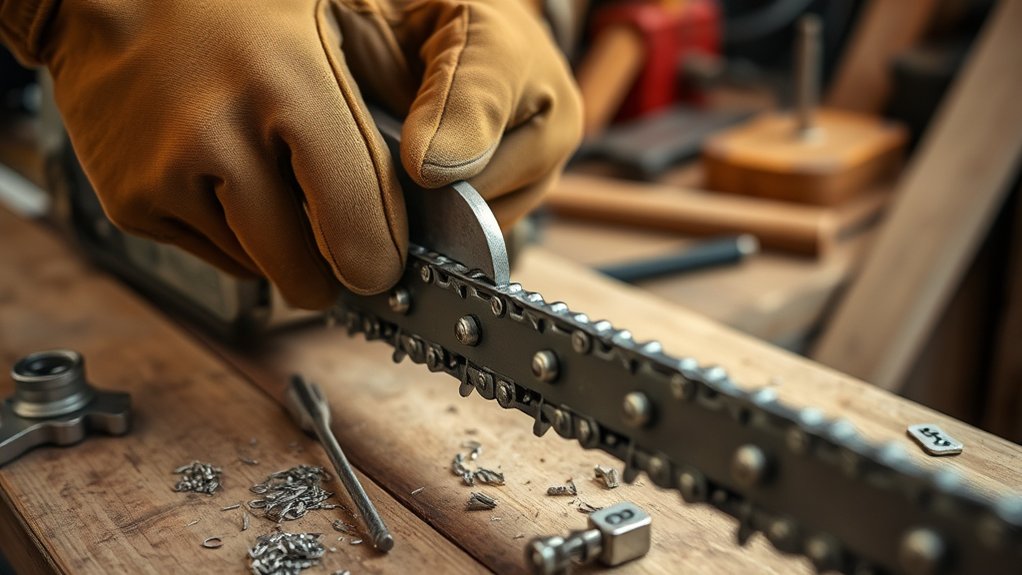
To file your chainsaw chain for clean cuts, first make sure the saw is off with the chain brake engaged. Then, secure it firmly before you start. Use a round file that matches your chain pitch and keep a filing angle between 25° and 35° using a gauge.
File all the teeth on one side evenly, then switch to the other side. Apply smooth, consistent strokes for the best results.
After filing the cutters, adjust the depth gauges so they are about 1/10 inch below the cutters using a flat file. Don’t forget to check the chain tension too. If wear is affecting performance, it might be time to replace the chain.
For more detailed steps and safety tips, just keep exploring the process. It’s worth it to get those clean, sharp cuts every time.
Get Your Chainsaw Chain Ready for Filing
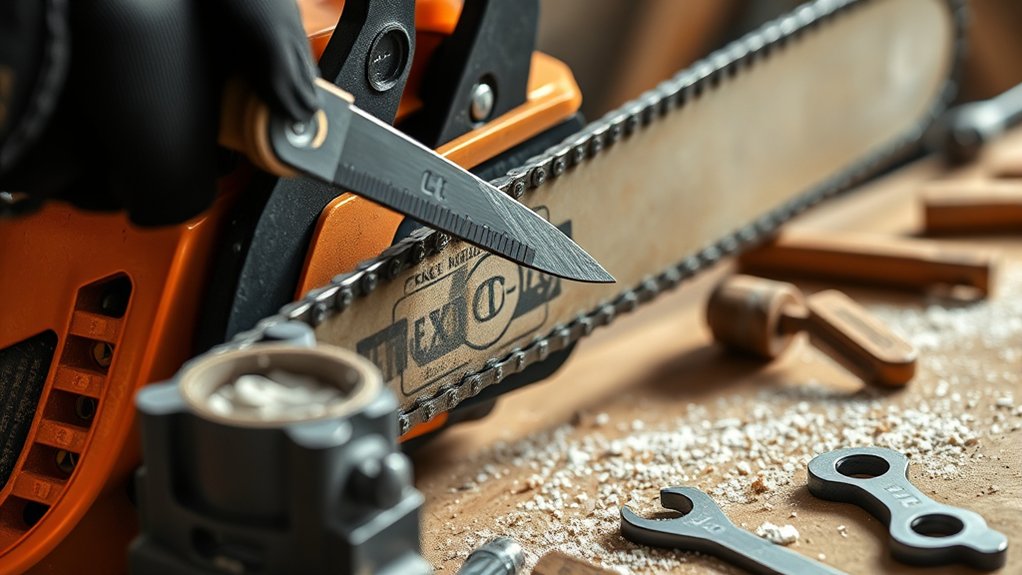
Before you start filing your chainsaw chain, make sure the saw is turned off, the chain brake is engaged, and it’s securely positioned on a stable surface to prevent accidents.
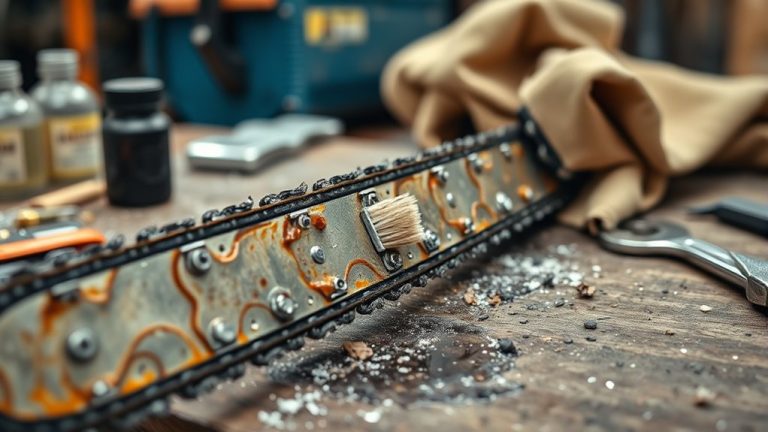
Begin by thoroughly cleaning the chain with a brush and degreasing detergent to remove sap and debris that can interfere with sharpening. Inspect each tooth carefully, identifying any damaged or excessively worn teeth, and mark the most worn one to maintain consistent sharpening.
Slightly increase the chain tension to reduce movement during filing. Use a round file that matches your chain’s specifications, typically between 3/16 and 7/32 inches in diameter.
Also, check and file the depth gauge if necessary to guarantee proper cutting depth.
Proper preparation guarantees precise, efficient sharpening and extends the life of your chainsaw teeth.
Choose the Right Chainsaw Files and Tools
You’ll want to pick a round file that matches your chain’s pitch, which is usually between 3/16 and 7/32 inches. This helps ensure your sharpening is spot on.
It’s also a good idea to use a filing gauge to keep the right angle—generally somewhere between 25° and 35°. Plus, a filing vice can be really handy to hold the chain steady while you work.
Don’t forget to keep other essential tools nearby, like a flat file for the depth gauges. Having all your necessary aids organized will definitely make the whole process smoother and quicker.
File Size Selection
When selecting files for your chainsaw chain, matching the file diameter to the chain pitch is crucial to guarantee proper sharpening. Use a round file that fits your chain’s pitch. Common sizes are 3/16″, 5/32″, or 7/32″.
Employ a filing gauge to maintain the correct filing angle, usually between 25° and 35°. This helps ensure efficient cutting teeth sharpening. Don’t overlook the depth gauge, which controls the raker height. It should be set about 1/10″ lower than the cutter teeth for maximum cutting performance.
| Chain Pitch | Recommended File Size | Purpose |
|---|---|---|
| 3/8″ | 7/32″ | Sharpening cutting teeth |
| .325″ | 5/32″ | Matching file diameter |
| 1/4″ | 3/16″ | Depth gauge adjustment with file |
Essential Sharpening Tools
Choosing the right sharpening tools is critical for maintaining your chainsaw’s cutting efficiency and safety. Use a round file sized to your chain pitch, commonly 3/16, 5/32, or 7/32 inches, to sharpen the cutting tooth precisely. A filing gauge helps maintain the ideal cutting angle, usually between 25° and 35°, guaranteeing consistent tooth geometry.
Stabilize the chain with a filing vice to achieve uniform filing strokes. For depth gauges, use a flat file to file them down to approximately 1/10 inch below the cutting teeth. This reduces kickback risk and improves cut quality.
Regularly maintaining both the cutting tooth with a round file and the depth gauges with a flat file prolongs chain life and guarantees clean cuts every time. It’s a simple routine that really makes a difference.
Set the Correct Filing Angle for Your Chainsaw Chain
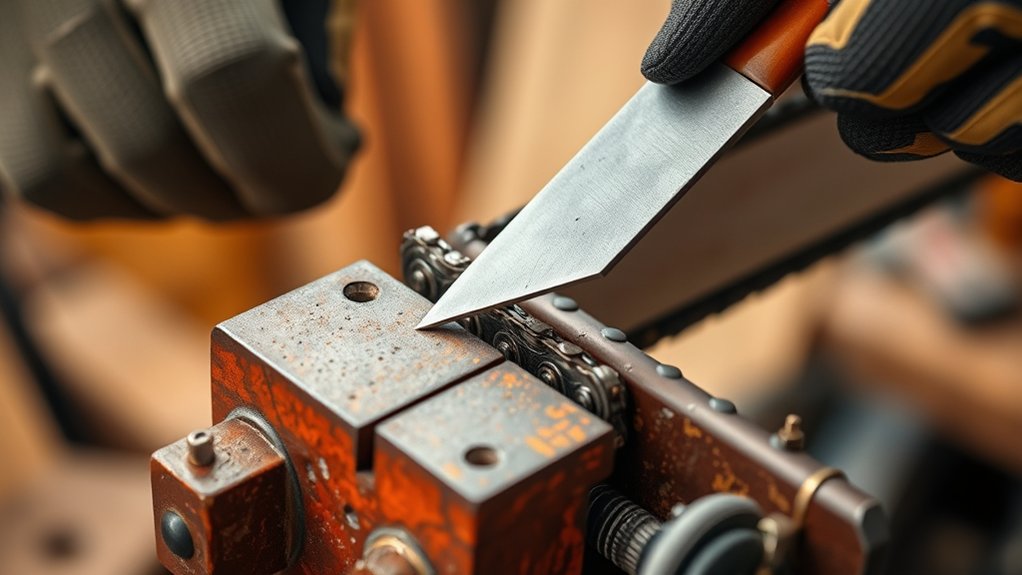
You’ll want to set the filing angle somewhere between 25 and 35 degrees, depending on what your chain’s specifications say.
It’s a good idea to use a filing gauge to keep that angle steady each time you sharpen.
Make sure to check the angle regularly to ensure even wear and to keep your chain cutting at its best.
Recommended Filing Angles
Although filing angles vary by chain type and manufacturer, most chainsaw chains require a precise angle between 25° and 35° for ideal sharpness and cutting efficiency.
The recommended filing angles depend on the brand. For example, STIHL chains typically call for a 30° angle, while Rapid Hexa chains perform best at 25°.
To maintain the correct angle, use a filing gauge designed for your chainsaw chain. This tool guarantees you file at the proper angle consistently.
That’s essential because the chain must remain sharp to cut efficiently and safely. Neglecting the correct angle leads to uneven wear and reduced cutting performance.
Angle Maintenance Techniques
Maintaining the correct filing angle is essential for achieving consistent sharpness and ideal cutting performance. To guarantee precise angle maintenance, use a filing gauge as a reliable reference tool for setting the correct filing angle, typically between 25° and 35°, based on your chain’s type.
Hold the file steady at this angle relative to each cutter to produce uniform cutting edges, which directly improve cutting efficiency.
File all cutters on one side before switching sides to assure even sharpening and balanced wear. Regularly verify and adjust the filing angle according to the manufacturer’s specifications to prevent uneven cutter degradation.
Consistent adherence to these techniques will maintain your chainsaw’s cutting precision and prolong the chain’s lifespan, ensuring peak performance with every cut.
File the Cutting Teeth Step-by-Step
Before filing the cutting teeth, make sure the chainsaw is turned off and securely positioned to prevent accidents.
Pick a round file that matches your chain size. This is usually 3/16, 5/32, or 7/32 inches.
Use a filing gauge to keep the manufacturer’s recommended filing angle, which is typically between 25° to 35°.
Maintain the proper filing angle of 25° to 35° using a filing gauge for optimal sharpening results.
Position the file on each cutter tooth and use smooth, even strokes with consistent pressure. Sharpen all teeth on one side before switching to the other.
Keep the chain properly tensioned against the guide bar while filing. This helps avoid uneven sharpening and chainsaw chatter.
It’s a good idea to regularly check the sharpness and make sure the depth gauges stay about 1/10 inch lower than the cutting teeth for efficient cutting.
Being precise during this step really pays off—it prevents poor cuts and helps your chain last longer.
File and Adjust Depth Gauges the Right Way
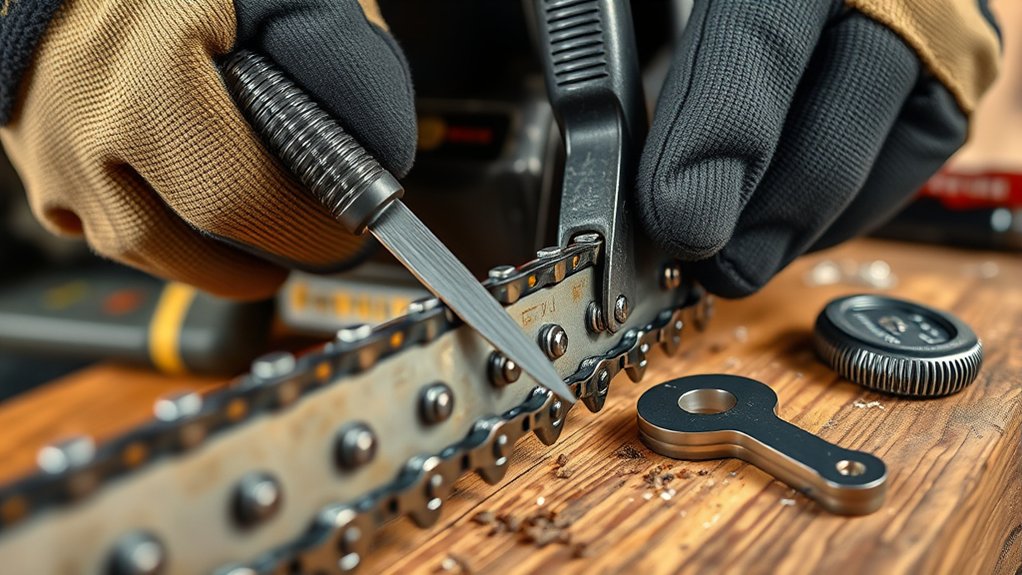
Once you’ve sharpened the cutter teeth, you need to file the depth gauges to maintain the correct clearance of about 1/10 inch below the cutters. This clearance is essential for optimal cutting performance and to reduce kickback risk.
Use a flat file and hold it parallel to the service mark on the depth gauges to guarantee consistent filing. A filing gauge helps verify this clearance precisely, so you don’t under- or over-file.
Check the depth gauges every 3-4 sharpenings to maintain proper cutting efficiency. Properly filing and adjusting depth gauges alongside sharpening the cutters guarantees your chainsaw cuts cleanly and safely.
It also prolongs chain life and enhances overall performance. Don’t skip this step; it’s critical to maintain the chain’s cutting precision.
Taking the time to file depth gauges right really pays off in the long run.
Check Chain Tension Before and After Sharpening
Two critical moments to check your chainsaw’s chain tension are immediately before and after sharpening.
Before you sharpen all the teeth, verify the chain tension is properly set to avoid safety risks and uneven filing. A correctly tensioned chain should fit snugly against the guide bar without hanging below it, allowing slight movement.
After sharpening, recheck chain tension since filing removes material, altering tightness. This step is important to keep your saw working safely and efficiently.
To check chain tension effectively:
- Consult your owner’s manual for model-specific tension specs.
- Use your fingers to lift the chain midway on the guide bar; it should snap back immediately.
- Adjust tension with the tensioning screw if needed.
- Confirm the chain moves smoothly but remains tightly seated.
Regularly checking chain tension keeps your saw efficient and safe.
It’s a simple habit that makes a big difference.
Sharpen Your Chainsaw Safely Out in the Field
After confirming the correct chain tension, you can safely begin sharpening your chainsaw in the field. First, secure the chainsaw on stable ground or use a filing vice. Always engage the chain brake to prevent accidental starts.
Select a round file that matches your chain size, usually between 3/16 and 7/32 inches. Follow the manufacturer’s guide and maintain a filing angle between 25° to 35°. Use smooth, even strokes away from your body.
After sharpening, check and adjust the depth gauges. They should be about 1/10 inch lower than the cutter teeth for the best cutting efficiency.
| Step | Key Detail |
|---|---|
| Secure chainsaw | Stable ground or filing vice |
| Chain brake | Engage before sharpening |
| File size | 3/16” to 7/32” round file |
| Depth gauge adjustment | 0.1” below cutter teeth |
Know When to Replace Your Chainsaw Chain
Although regular sharpening can extend your chainsaw chain’s life, you need to replace it when you notice cracks, broken teeth, or excessive stretching that affects tension. Ignoring significant wear compromises both safety and cutting efficiency.
Here are key signs to replace the chain:
- Excessive stretching causes poor tension, reducing cutting power.
- Dullness beyond sharpening results in fine sawdust or smoke during cuts.
- Uneven tooth lengths from repeated sharpening impair cutting accuracy.
- The chain consistently pulls to one side despite correct sharpening and tension adjustments.
If you notice any of these problems, it’s best to replace the chain promptly to keep your saw running safely and smoothly.
Regularly inspecting your chain helps you figure out when sharpening just won’t cut it anymore, so you can enjoy clean, precise cuts every time.
Frequently Asked Questions
How Often Should I File My Chainsaw Chain for Optimal Performance?
You should file your chainsaw chain every 3-4 hours of heavy use to keep it performing at its best. This helps maintain the sharpness and efficiency of the chain.
Be sure to follow a filing frequency guide so you don’t end up with uneven sharpening. It’s a common mistake but easy to avoid with the right approach.
Use proper tools like a round file and a filing guide to get the best results. You might want to try different sharpening methods and see which one feels easiest and most effective for you.
Regular chain maintenance is key to smooth cuts and longer chain life. Taking a little time for upkeep can save you a lot of hassle down the line.
Can I Use a Chainsaw File on Any Brand of Chain?
You can use a chainsaw file on most brands, as long as the file size matches the chain’s pitch, ensuring brand compatibility.
Different file types suit various chain materials, so selecting the right diameter is key. Applying proper sharpening techniques and maintaining your file sharp prevents performance impact.
Always check your chain’s manual for specific recommendations.
Following these maintenance tips helps you achieve clean, efficient cuts regardless of the brand. It’s pretty straightforward once you know what size and type of file to use!
What Are the Signs of a Dull Chainsaw Chain Besides Poor Cutting?
You’ll notice signs like smoke during cutting despite correct chain tension and lubrication, which means there’s increased friction from dull teeth. The chainsaw may chatter or bounce, making it harder to control.
Uneven cuts often happen because of inconsistent sharpening angles or chain damage.
Cutting speed slows down no matter what kind of wood you’re working with. Instead of producing wood chips, you’ll see fine sawdust.
If you fall behind on your maintenance schedule, these symptoms can get worse. That’s a clear sign it’s time to sharpen or replace the chain.
How Do Environmental Conditions Affect Chainsaw Chain Sharpening?
Did you know humidity can increase chain rust by up to 30%? Weather impact directly affects your chainsaw’s maintenance frequency. High humidity causes rust, which dulls your chain faster.
Temperature changes, especially cold weather, make wood harder and increase wear on your chain.
Soil type matters too. Sandy or muddy conditions can embed debris in the teeth, meaning you’ll need to file more often.
Wood density also plays a role in how quickly your chain dulls. Hardwoods require sharper chains more frequently.
Is It Necessary to Wear Protective Gear When Filing a Chainsaw Chain?
Yes, you must wear protective gloves and eye protection during chainsaw maintenance to comply with safety regulations and prevent injuries.
Protective gloves shield your hands from sharp edges and metal shavings when applying filing techniques, while eye protection guards against flying debris.
Also, if there are power tools operating nearby, it’s important to protect your hearing.
Using hearing protection helps you avoid noise-induced hearing loss.
Taking these precautions keeps your sharpening process safe and efficient.
It’s definitely worth the extra effort to stay protected!
Conclusion
Mastering chainsaw chain filing transforms you into a precision-cutting maestro, ensuring every stroke slices like a razor through timber. By choosing the right tools, setting exact angles, and maintaining tension, you’ll achieve unparalleled sharpness that feels almost supernatural.
Don’t underestimate the power of proper depth gauge adjustment and safety in the field. These details really elevate your work from ordinary to extraordinary. Sharpen with care, or risk dullness that grinds your productivity to a halt.