How To Adjust Carb On Chainsaw – Tuning Tips That Work
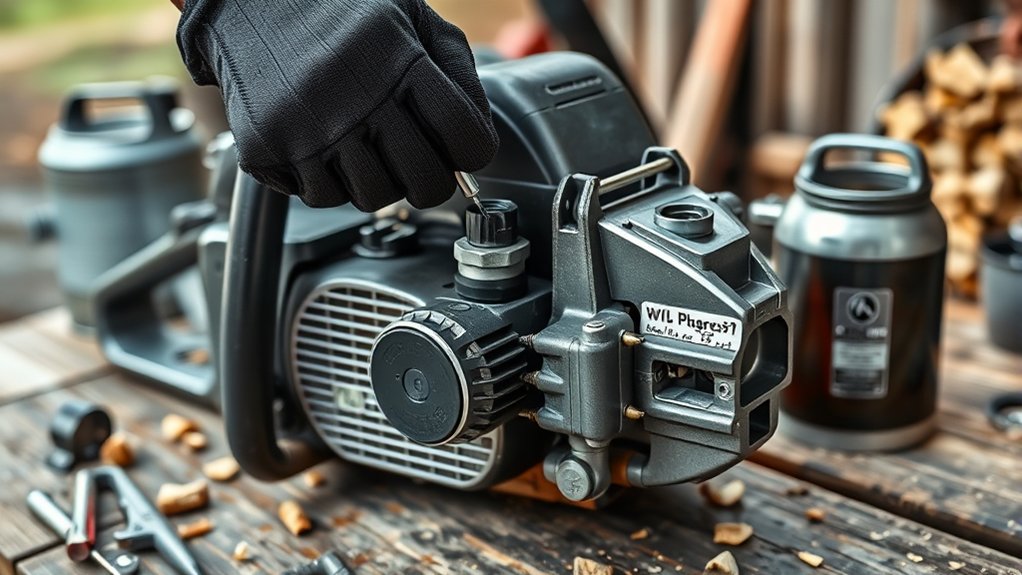
To adjust your chainsaw carburetor, start by locating the low- and high-speed screws, which are usually marked on the side of the carburetor. Warm up the engine first. Then, turn the low-speed screw to get a steady idle without the chain moving.
Next, fine-tune the high-speed screw while keeping an ear on the engine sound and watching the RPMs. You want smooth performance close to 13,500 RPM. Checking the spark plug color is a great way to verify if your tuning is spot on.
Proper maintenance and paying attention to sound cues help prevent engine damage and keep your chainsaw running efficiently. If you want, you can learn more about optimizing these steps for even better results.
Identify the Low-Speed and High-Speed Screws on Your Chainsaw Carburetor
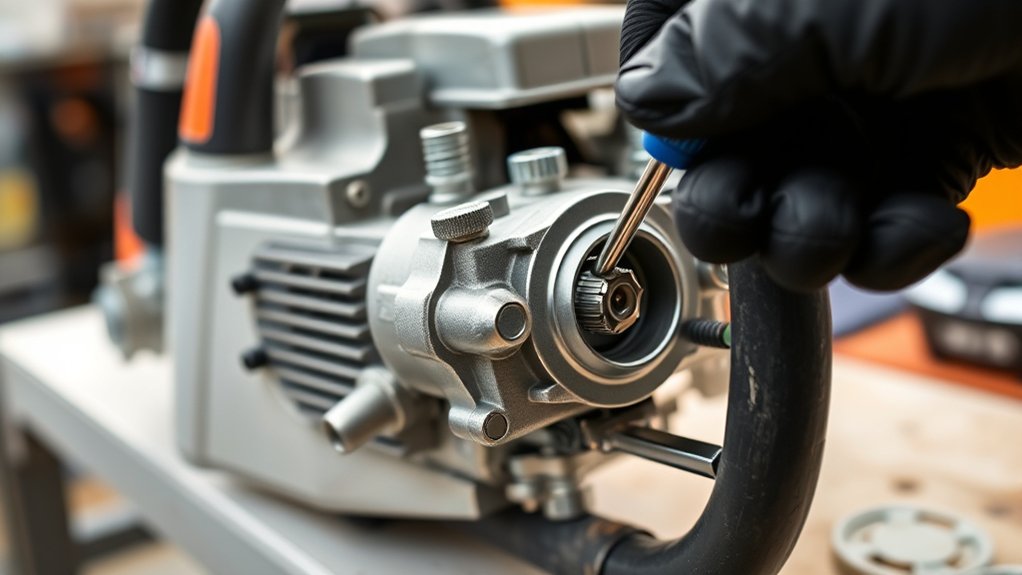
Before adjusting your chainsaw’s carburetor, you need to identify the low-speed and high-speed screws. These screws control the fuel-air mixture at different engine speeds.
The low-speed screw manages the mixture at idle and low RPMs, typically set between 1 to 1.5 turns out from the seat for stable idling.
The low-speed screw controls fuel mixture at idle, usually set 1 to 1.5 turns out for smooth idling.
The high-speed screw handles the mixture during wide-open throttle (WOT) conditions, also initially adjusted 1 to 1.5 turns out. Both screws are located on the carburetor’s side and can be recognized by distinct markings or shapes.
Adjusting the low-speed screw affects engine idling stability, while the high-speed screw influences acceleration and peak RPM.
Always consult your chainsaw’s owner’s manual for exact screw locations and initial settings to guarantee precise adjustments. This way, you make sure everything is set just right before you start tuning.
Prepare Your Chainsaw for Carburetor Adjustment
First, make sure your fuel is fresh and mixed exactly how the manufacturer recommends.
Then, take a look at the fuel filter and line to see if there are any blockages or leaks.
Next up, clean or swap out the air filter if it’s dirty.
Don’t forget to check the spark plug too — it should be clean and have the right gap to ensure reliable ignition.
Before you start warming up the chainsaw to get ready for the carburetor adjustment, always put on the proper safety gear.
Safety first!
Fuel And Filter Check
Three key checks guarantee your chainsaw’s fuel system is ready for carburetor adjustment: verifying fresh fuel mix, inspecting the fuel filter, and examining the fuel line.
Start by ensuring you use a fresh 50:1 gasoline-to-two-stroke oil mix. Stale fuel compromises engine performance and tuning accuracy.
Next, remove and inspect the fuel filter. Clean it or replace it if you spot dirt or blockages to maintain proper fuel delivery.
Finally, scrutinize the fuel line for cracks or leaks that could disrupt fuel flow to the carburetor. Make sure fuel reaches the carburetor effectively because inadequate flow leads to stalling or inconsistent engine response during adjustments.
Completing these fuel and filter checks sets a solid foundation for precise carburetor tuning and peak chainsaw operation.
Spark Plug Inspection
Although fuel quality and filter condition are essential, inspecting the spark plug is equally important to guarantee your chainsaw runs smoothly during carburetor adjustment.
Start by checking the spark plug gap, which should be between 0.020 and 0.025 inches for ideal ignition.
Also, inspect the spark plug for wear signs like carbon buildup or a burned electrode, as these impair engine performance.
Cleaning the spark plug with a wire brush or specialized cleaner will help remove debris and ensure good conductivity.
If the spark plug shows significant wear, go ahead and replace it to improve starting and efficiency.
Finally, make sure the spark plug is securely connected. A loose connection can cause misfiring and inconsistent engine operation, which only makes carburetor tuning more complicated.
Proper spark plug inspection really sets the foundation for effective carburetor adjustment.
Safety Gear Preparation
Inspecting the spark plug guarantees your chainsaw runs reliably, but before adjusting the carburetor, you need to gear up properly.
Start by wearing appropriate safety gear. Safety goggles protect your eyes from flying debris during adjustments, while gloves prevent cuts and improve your grip on chainsaw components.
Don’t forget hearing protection to shield your ears from loud engine noise when the chainsaw is running. Always make sure you perform adjustments in a well-ventilated area to avoid inhaling harmful fumes.
Before you begin, confirm the chainsaw is turned off and cool to the touch.
Proper safety gear preparation minimizes risks and ensures a safe, efficient carburetor adjustment process.
Prioritize these steps to maintain control and protect yourself throughout the tuning. It’s worth taking the time to suit up right before you start.
Adjust the Low-Speed Screw for Smooth Idling
Before adjusting the low-speed screw, let your chainsaw warm up for a few minutes. This helps guarantee accurate tuning.
Use the idle screw to fine-tune smooth idling. Turn it counterclockwise until the engine runs steadily without stalling or the chain moving. If it stalls when tipped forward, the low-speed screw needs more adjustment.
Rev the throttle to test response. If it hesitates, turn the idle screw clockwise slightly to enrich the mixture and improve acceleration.
After adjustments, inspect the spark plug color. A light tan color indicates ideal tuning. A dark or wet plug means the mixture is too rich.
- Aim for steady idle with no chain movement
- Prevent stalling by fine-tuning the idle screw
- Check throttle response and spark plug condition
Check Carburetor Idle Speed and Prevent Chain Movement
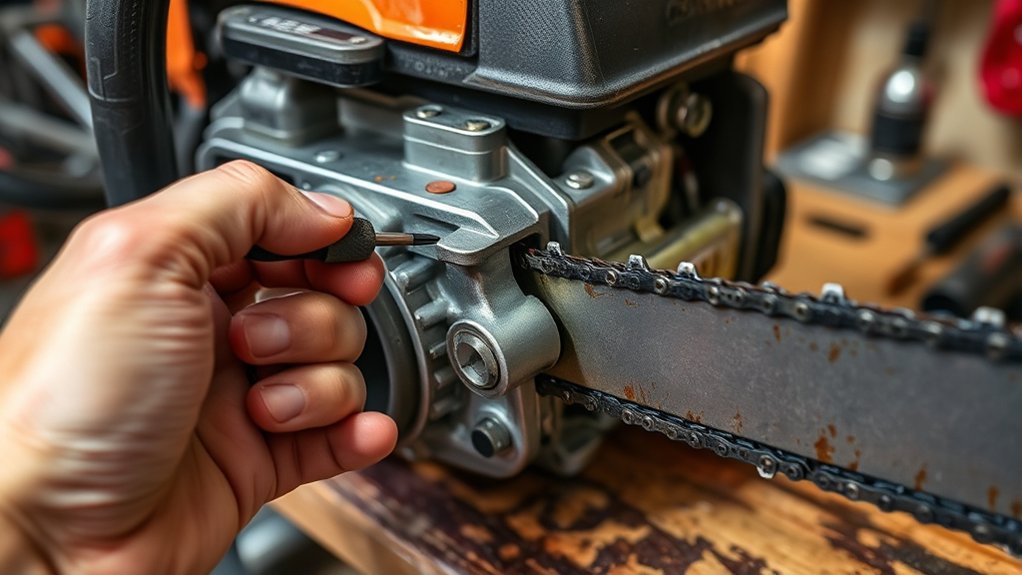
When you check the carburetor idle speed, make sure your chainsaw rests on a flat surface with the chain free of any load to prevent accidental rotation.
Start by adjusting the low-speed screw, typically about 1.5 turns counterclockwise from closed, to achieve smooth idling without chain movement.
Monitor closely. If the chain starts to move, fine-tune the screw clockwise to lean the mixture and stop chain rotation. The goal is a steady idle for at least 30 seconds without stalling, indicating ideal fuel-air balance.
Remember, a clogged air filter can disrupt idle speed and cause unwanted chain movement.
Fine-Tune the High-Speed Screw for Optimal Engine Performance
Start by running the saw at full throttle.
Listen closely for a high-pitched scream—that’s a sign the mixture is too lean and needs adjusting.
Next, gradually turn the high-speed screw to add more fuel.
Keep doing this until the engine sound smooths out and runs steadily.
Make sure the RPM stays close to 13,500.
This helps avoid engine damage while keeping performance at its best.
Identifying Engine Sound
Although fine-tuning the high-speed screw requires careful attention, you can identify the engine’s condition by listening closely to its sound at full throttle. Identifying engine sound helps you detect whether the mixture is too lean or rich without guesswork.
A high-pitched “scream” signals a lean mixture, meaning you’ll need to richen the high-speed screw setting. Conversely, if the engine “flutters” or bogs down, the mixture is too rich, so lean it slightly.
Key points for identifying engine sound:
- High-pitched scream = lean mixture, richen adjustment
- Fluttering or bogging = rich mixture, lean adjustment
- Clean, strong sound after revving = ideal tuning
Use these audio cues as reliable indicators before making any carburetor adjustments. It’s a simple way to get your engine running just right without any guesswork.
Adjusting High-Speed Screw
One essential step in tuning your chainsaw’s carburetor is adjusting the high-speed screw to achieve peak engine performance. Start by loosening it gradually if you hear a high-pitched “screaming” sound. That sound usually signals a lean mixture.
Rev the engine at full throttle for about five seconds, watching for fluttering or bogging. If the engine stumbles, slightly richen the mix by turning the high-speed screw counterclockwise until it runs smoothly. Make small adjustments, about 1/8 to 1/4 turn, and test after each change.
Your goal is a clean run under load without excessive smoke. Too much smoke means the mix is too rich.
| Symptom | Adjustment Direction | Expected Result |
|---|---|---|
| Screaming sound | Loosen screw | Leaner mixture |
| Engine bogs | Tighten screw | Richer mixture |
| Excess smoke | Tighten screw slightly | Smooth, clean running |
Ensuring Safe RPM Levels
When you fine-tune the high-speed screw, keep a close eye on the chainsaw’s RPM at wide open throttle to avoid exceeding the safe limit of about 13,500 RPM.
Maintaining safe RPM levels prevents engine overheating and piston damage. Use a tachometer for accurate RPM readings and listen carefully to engine sounds.
A high-pitched scream signals a lean mix, while bogging indicates a rich mixture. Adjust the screw until the engine runs smoothly without stumbling.
Key tips for ensuring safe RPM levels:
- Monitor RPM with a tachometer for precision.
- Adjust the high-speed screw gradually to balance air-fuel mix.
- Stop tuning if RPM exceeds 13,500 or engine sounds abnormal.
This approach keeps your chainsaw running efficiently and protects engine health.
Use Engine Sounds to Tune Your Chainsaw Carburetor
Listen closely to your chainsaw’s engine sounds as you adjust the carburetor, since they offer immediate clues about the fuel mixture. A high-pitched “scream” when revving signals a lean condition. Richening the high-speed screw will help.
Conversely, a fluttering noise during acceleration means the mixture is too rich. Turn the high-speed screw to lean it out. If the engine stumbles at wide open throttle, it’s running too lean and needs to be richened for smoother operation.
At idle, a steady purr indicates correct low-speed tuning, while a rough idle suggests adjustment is needed. By paying attention to these sounds, you can effectively tune a chainsaw carburetor, ensuring peak performance and preventing damage.
Regular monitoring during adjustments is key to success. So, keep your ears open and make small tweaks as you go for the best results.
Watch Out for These Common Carburetor Tuning Mistakes

Although adjusting your chainsaw’s carburetor might seem straightforward, overlooking key steps can quickly lead to poor performance or even engine damage. To avoid common mistakes, always consult your owner’s manual for specific carburetor settings.
Adjusting your chainsaw’s carburetor requires careful steps to prevent engine damage and ensure optimal performance.
Don’t over-adjust the high-speed screw; running the engine too lean causes overheating and damages internal components.
Also, never tune a cold engine. Let it warm up first for accurate adjustments. Neglecting to check the spark plug before tuning can lead you to misdiagnose issues, wasting time and risking improper carburetor settings.
Finally, using a tachometer guarantees precise RPM readings, which helps prevent unsafe conditions and suboptimal performance. It’s a simple tool that makes a big difference.
Watch out for these common carburetor tuning mistakes:
- Ignoring manufacturer’s adjustment guidelines
- Over-tightening the high-speed screw
- Skipping engine warm-up before tuning
Carburetor Maintenance Tips for Long-Lasting Chainsaw Performance
Since a well-maintained carburetor directly affects your chainsaw’s efficiency and lifespan, you should regularly clean and inspect key components like the air filter, spark plug, and fuel system.
Wash paper air filters with hot water and soap. For wire filters, use chainsaw gas to guarantee proper airflow.
Check the spark plug for cleanliness and the correct gap. Replace it if necessary to keep ignition quality high.
Also, inspect fuel lines and filters for blockages, and always use fresh, properly mixed fuel.
Adjust the carburetor’s low and high-speed adjustment screws according to the manufacturer’s specs to optimize the air-fuel mixture and prevent stalling.
Plus, clean the muffler and spark arrestor regularly to avoid exhaust buildup. This buildup can reduce engine performance and shorten your chainsaw’s operational life.
Frequently Asked Questions
What Tools Do I Need to Adjust My Chainsaw Carburetor?
You’ll need a flathead screwdriver to access and turn the carburetor’s adjustment screws. It’s essential for mastering Carburetor Basics.
A tachometer helps you monitor RPM accurately, so you can tune it just right.
Use a fuel mixture tool to confirm the right fuel-to-oil ratio, which is typically 50:1.
Don’t forget safety gloves and goggles for protection, plus a clean cloth to wipe off dirt.
These tools keep your adjustments effective and safe.
How Often Should I Adjust My Chainsaw Carburetor?
If you love surprises like stalling or rough idling, ignore carburetor symptoms and never adjust your chainsaw carb.
Otherwise, tune it at least once a year to avoid those headaches.
Notice carburetor symptoms like difficulty starting or power loss? Adjust more frequently, especially after changing the air filter or spark plug.
Heavy use or seasonal shifts call for checking every few months to maintain sharp, reliable performance without unwanted surprises.
Can a Dirty Air Filter Affect Carburetor Tuning?
Yes, a dirty air filter directly impacts airflow, which affects carburetor tuning.
When airflow is restricted, your chainsaw gets a richer fuel mixture, causing poor combustion and stalling.
This makes it hard for you to set the carburetor correctly because the engine won’t reach ideal RPMs.
To guarantee precise tuning, clean or replace the air filter regularly.
Maintaining proper airflow is essential for smooth operation and accurate carb adjustments.
It really helps keep your chainsaw running the way it should.
What Fuel Mixture Is Best for My Chainsaw Carburetor?
You should use a 50:1 fuel mixture, which means 2.6 ounces of two-stroke oil per gallon of high-quality gasoline with at least an 89 octane rating.
This ratio guarantees proper lubrication and combustion. It’s essential for getting the best fuel quality and carburetor performance.
Always mix fresh fuel, ideally under 30 days old.
Use oil designed specifically for two-stroke engines to prevent wear. This helps maintain your chainsaw’s efficiency and longevity.
Is It Safe to Adjust the Carburetor Without Professional Help?
You can adjust the carburetor without professional help if you understand safety concerns and follow the manufacturer’s guidelines closely.
Always wear gloves and goggles to protect yourself. Use a tachometer to verify correct RPM settings and avoid engine damage.
If you’re unsure or the chainsaw behaves abnormally, seek professional assistance.
Proper maintenance and cleaning before adjustments also improve safety and performance. This way, you minimize risks during tuning.
Conclusion
Mastering your chainsaw’s carburetor calls for careful calibration and consistent care. By balancing the low-speed and high-speed screws, you’ll boost both idle stability and engine efficiency. Avoid common carburetor mistakes by maintaining meticulous maintenance and monitoring motor sounds.
This sharp, systematic tuning safeguards smooth starts, steady speeds, and strong saw performance. Stay sharp, stay safe, and keep your chainsaw cutting clean with these practical, precise carburetor adjustments.