How To Start A Chainsaw – Step By Step Guide
To start a chainsaw safely, first prepare your work area by clearing debris and guaranteeing good ventilation. Perform safety checks like inspecting chain tension, lubrication, and the chain brake. Familiarize yourself with controls and assume a stable stance with the chain brake engaged.
For cold starts, use the choke. For hot engines, avoid it. Pull the starter cord firmly until the engine fires, then allow it to warm up before use.
Following these steps guarantees safety and peak performance. Next, you’ll find detailed guidance tailored to your specific chainsaw model.
Prepare Your Work Area for Safe Chainsaw Use
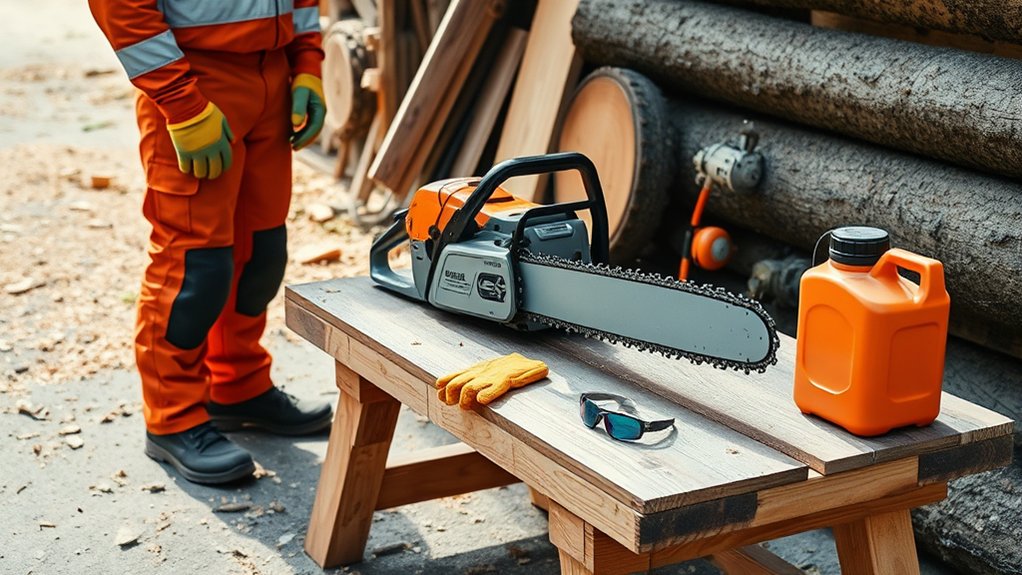
Before you start your chainsaw, make certain you set up your work area properly to guarantee safety.
Always operate outdoors or in a well-ventilated space to prevent harmful exhaust buildup. Inspect the area thoroughly for uneven ground, debris, and slippery surfaces to avoid falls or accidents.
Operate in well-ventilated areas and inspect for hazards to prevent accidents and exhaust buildup.
Keep children and pets at least 10 feet away from your working area to maintain a safe distance. Establish a clear escape route in case you need to move quickly.
Refuel safely by doing so at least 10 feet away from where you’ll be cutting, minimizing fire risks.
Avoid hazards by removing obstacles and checking for overhead power lines.
Finally, never work alone; having someone nearby guarantees immediate help if an emergency occurs. This creates a safe environment for efficient chainsaw operation.
Perform Safety Checks Before Starting Your Chainsaw
Although preparing your work area is essential, you must also perform thorough safety checks on your chainsaw before starting it.
First, check the chain tension and chain lubrication to guarantee smooth operation and reduce the risk of accidents. Inspect the chain brake, verifying the inertia function activates correctly by releasing the front handle while holding the saw over a stable surface.
Confirm the throttle lockout engages properly to prevent unintended throttle activation. Examine the air filter for cleanliness and replace it if dirty or damaged to maintain engine performance.
Verify the manual fuel pump functions, assuring proper fuel delivery.
Always wear personal protective equipment and assume a stable operating position before starting.
These safety considerations are critical to safe, efficient chainsaw use and preventing injury. It’s really worth taking the time to do these checks every time you use your saw.
Get to Know Your Chainsaw Controls
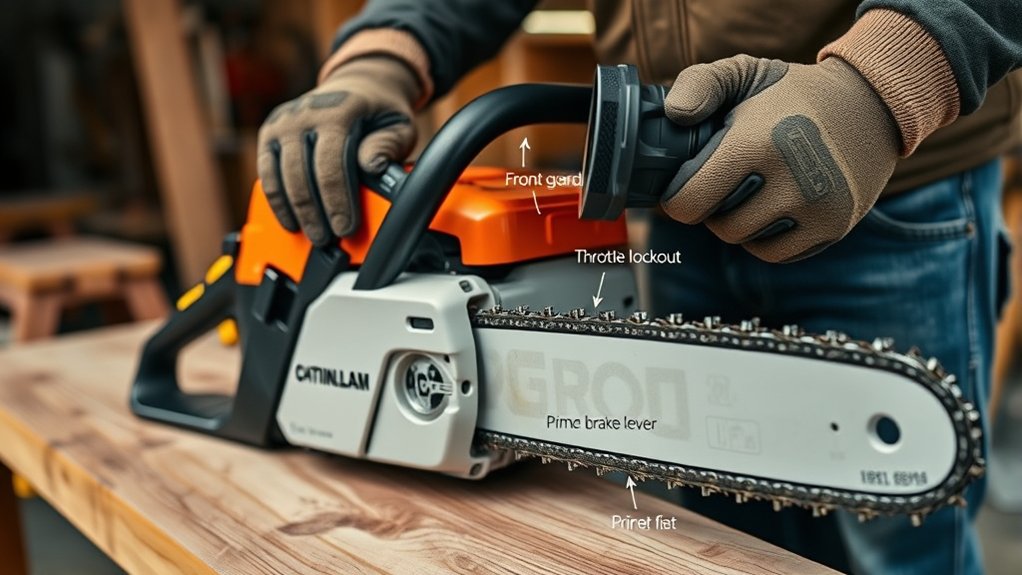
You should get to know the Master Control Lever™ really well since it helps you adjust the choke and throttle settings for a smooth start.
Before you fire up the chainsaw, always make sure the chain brake is engaged—that way, the chain won’t move unexpectedly.
Getting comfortable with these controls is key to using your chainsaw safely and effectively.
Master Control Lever
The Master Control Lever plays an essential role in managing your STIHL chainsaw’s choke and throttle settings, ensuring the engine starts and runs smoothly.
When starting a cold engine without STIHL M-Tronic, set the lever to the choke/cold start position to enrich the fuel mixture for engine start.
Models equipped with M-Tronic simplify this by using the start position (▲), which automatically adjusts settings for peak function.
Once the engine fires, promptly move the lever to the operating position (I) to engage the throttle correctly and maintain steady operation.
Understanding these positions on the Master Control Lever is critical for efficient startup and safe handling.
Always follow safety considerations, ensuring the correct setting to avoid engine flooding or stalling during your cutting tasks.
Chain Brake Function
One critical safety component on your STIHL chainsaw is the chain brake. It’s designed to prevent accidental chain movement during startup and operation. This safety feature lets you engage the chain brake by pushing the front handle forward, which locks the chain before you start the engine.
The chain brake also activates automatically during a kickback event. This quickly stops the chain and helps reduce the risk of injury.
To make sure your chainsaw handles reliably, regularly check the chain brake function by performing an inertia test. Just release the front handle and see if the brake engages.
It’s a good idea to get familiar with where the chain brake control is and how it works. Using it properly is key to preventing accidental chain movement and keeping your operation safe at all times.
Choose the Best Starting Position
Three key points will help you choose the best starting position for your chainsaw to guarantee safety and control.
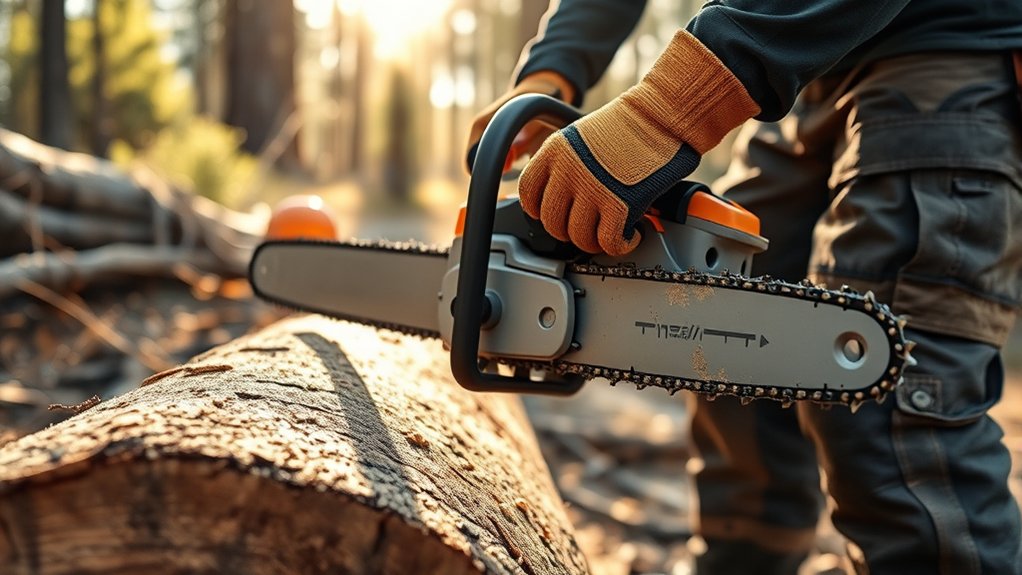
First, place your right foot firmly on the rear handle to stabilize the saw on a flat surface.
Second, grip the front handle with your left hand, keeping your left arm straight to maintain control and prevent injury.
Third, position the rear handle securely between your left thigh and right knee for added stability.
Before pulling the starter cord, always engage the chain brake to prevent accidental chain movement. This setup guarantees the chainsaw remains stable and under control during startup.
By stabilizing the saw with your right foot and left hand and maintaining a firm grip on both handles, you’ll optimize safety and efficiency while starting your chainsaw.
It really helps to keep everything steady so you can start smoothly without any surprises.
Start a Chainsaw Without STIHL M-Tronic
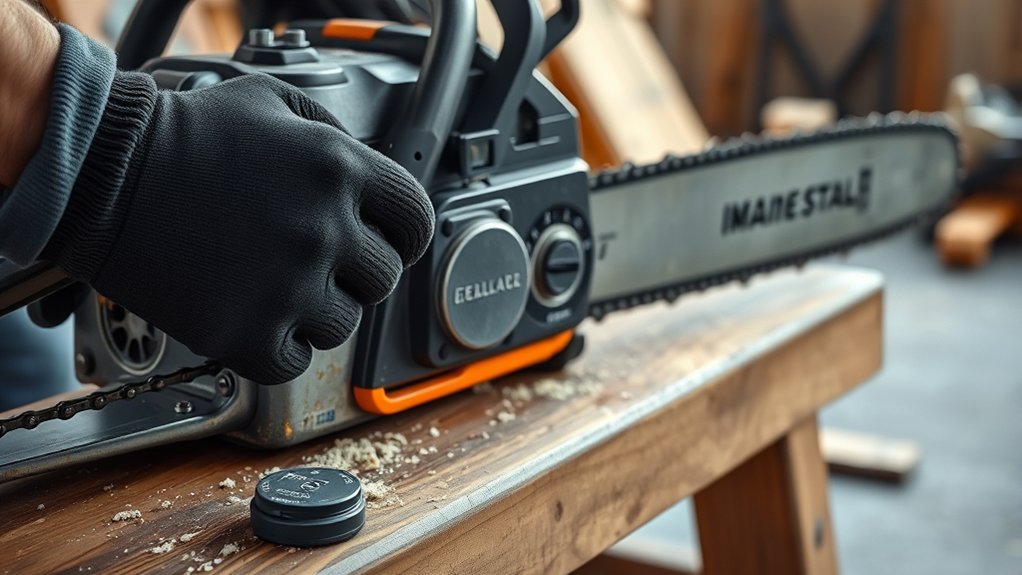
After securing your chainsaw in the ideal starting position and engaging the chain brake, you’re ready to start a saw without STIHL M-Tronic™.
First, push the chain brake handle forward and remove the scabbard for safety and access. Set the Master Control Lever to the choke/cold start position to prepare the engine for ignition.
If your model includes a decompression valve, press it to reduce cylinder pressure, which makes pulling the starter cord easier.
Next, pull the starter cord slowly until you feel resistance, then pull it firmly to start the engine. Once the engine fires up, adjust the Master Control Lever to half-throttle.
Before you begin cutting, make sure to check the chain lubrication. This ensures everything runs smoothly and keeps you safe while using the saw.
Start a Chainsaw With STIHL M-Tronic
Although STIHL M-Tronic simplifies engine management, you still need to follow proper safety steps before starting. First, engage the chain brake and remove the chain guard.
Use the decompression valve to reduce cylinder pressure and the manual fuel pump to prime the engine if necessary.
Next, set the Master Control Lever to the start position (▲) to prepare the ignition system. Pull the starter cord firmly until the engine fires. Once it does, tap the throttle trigger to disengage the high idle setting.
After the engine runs steadily, check chain lubrication thoroughly to guarantee peak performance and safety.
These steps help you start a chainsaw with STIHL M-Tronic efficiently while maintaining control and preventing unexpected chain movement.
How to Start a Cold Engine Step by Step
Before you start a cold engine, the first thing you want to do is activate the chain brake for safety. It’s a simple step, but super important.
If your saw comes with a fuel pump, go ahead and prime the fuel system next. This helps get the fuel flowing smoothly.
Now, set the choke all the way on. This makes sure the air-fuel mixture is just right for ignition when the engine is cold.
When you’re ready, use controlled pulls on the starter handle to get the engine firing up.
Once the engine starts to catch, adjust the choke to about half-throttle. This helps the engine warm up properly before you start using the saw fully.
And that’s it—you’re good to go!
Cold Engine Preparation
Starting a cold chainsaw engine requires a specific sequence of steps to guarantee safety and efficient ignition. First, engage the chain brake to prevent accidental chain movement. This is a critical safety consideration.
Next, press the primer bulb repeatedly until fuel is visible, making certain the carburetor is primed for easier starting. Set the choke to the “on” position to enrich the fuel mixture for a cold start.
Firmly pull the starter handle; when you feel resistance, pull sharply until the engine fires. This may take several attempts.
Once the engine fires, push the choke in to the half-throttle position to allow warming. Finally, release the chain brake only when you’re ready to operate.
Following this precise process guarantees a safe, reliable cold engine start.
Choke And Starter Use
To start a cold engine effectively, follow a clear sequence using the choke and starter. First, engage the chain brake and set the choke to the “on” position to restrict air intake, which makes ignition easier.
Press the air purge bulb until fuel appears to prime the carburetor.
Then, firmly pull the starter handle until the engine fires. Once it sputters, push the choke to the half-throttle position to allow more air for smoother starting.
If the engine doesn’t start after several pulls, check that the choke is correctly positioned and the throttle isn’t fully closed.
When the engine starts, let it idle and warm up before releasing the chain brake.
This sequence helps guarantee safe, efficient starting and protects the engine’s components during initial operation. Following these steps will make your starting process smoother every time.
How to Start a Hot Engine Smoothly
Engage the chain brake and pull the starter handle firmly to ignite a hot chainsaw engine without using the choke. Since the hot engine is already warm, avoid activating the choke to prevent flooding.
Before starting, always check the chain lubrication to guarantee peak performance and reduce wear.
If the engine doesn’t start immediately, push the choke to half-throttle and pull the starter cord again. Should the engine still fail to start, apply half-throttle by fully pushing the choke, then return it to the start position while pulling the starter cord.
Maintaining the chain brake engaged throughout the process is critical for safety. Following these steps guarantees you start a hot engine smoothly, safely, and with peak performance.
Frequently Asked Questions
How Often Should I Sharpen My Chainsaw Chain?
You should sharpen your chainsaw chain after every 3 to 5 tankfuls of fuel to keep it cutting efficiently. Using the right tools is important—like a round file that matches your chain type.
Make sure to maintain proper chain tension and stick to the correct sharpening angles. This helps you get consistent results every time.
Don’t forget to wear safety gear while sharpening.
Also, include this sharpening routine in your regular maintenance schedule. It’ll help prevent wear and keep your chainsaw running safely and effectively.
What Type of Fuel Mix Is Best for My Chainsaw?
The best fuel mix for your chainsaw uses a 50:1 ratio of high-quality 2-stroke engine oil to unleaded gasoline with at least an 89 octane level.
This balance optimizes engine performance, reduces emissions impact, and prevents knocking.
Avoid fuels with over 10% ethanol and store the mixture in a sealed container.
Make sure to use it within 30 days to keep it fresh.
Stick to brand recommendations and mix thoroughly.
If you run into issues, troubleshoot by checking for fuel contamination or improper ratios.
This will help maintain safety and efficiency.
How Do I Properly Store a Chainsaw After Use?
To properly store your chainsaw after use, start with thorough cleaning procedures to remove debris and make sure the chain lubrication is intact.
Stabilize the fuel or empty the tank to keep fuel storage safe. Use a protective covering and bar protection to guard against moisture and damage.
Choose a storage location with humidity control, and keep it away from children and pets. Always follow safety precautions by engaging the chain brake before you put it away.
Also, if winter is coming, check the fuel stabilization to prevent degradation.
Taking these steps will help keep your chainsaw in good shape and ready for the next time you need it. It’s all about making sure it’s clean, safe, and stored in the right spot.
Can I Use a Chainsaw in Wet or Rainy Conditions?
You can use a chainsaw in wet conditions, but safety precautions are critical since 30% of chainsaw accidents happen in slippery environments.
Wet conditions reduce chain performance and cutting efficiency, which increases wear. So, be extra careful when working in the rain or after a storm.
Avoid electrical hazards by never using electric saws when things are wet. Gas-powered models are a safer choice in these situations.
Always prioritize your personal protective gear and make sure you have stable footing before starting your work.
For maintenance, check lubrication frequently to keep your equipment in good shape.
Your experience as an operator and the current weather should always guide your decision on whether or not to use a chainsaw in wet conditions.
What Maintenance Is Required to Keep My Chainsaw Running Smoothly?
To keep your chainsaw running smoothly, regularly perform chainsaw cleaning tips like bar cleaning methods and chain tension adjustment.
Practice proper oiling techniques and check your oil levels often. Prioritize air filter maintenance and spark plug replacement to guarantee engine efficiency.
Don’t forget fuel filter care and follow winter storage practices to prevent damage.
Always wear safety gear essentials when troubleshooting issues, and maintain your saw precisely for reliable, safe operation.
Taking these steps will help you get the most out of your chainsaw and keep it working safely every time you need it.
Conclusion
Now that you know the exact steps to start your chainsaw safely and efficiently, are you ready to put this knowledge into action? Always double-check your work area and controls before you begin. Whether you’re using STIHL M-Tronic or a standard model, following these precise procedures reduces risk and guarantees smooth operation.
Remember, safety isn’t optional. It’s the foundation of every successful job with your chainsaw. Stay sharp and stay safe!